Blog
Offline Conversion Tracking for B2B SaaS: How It Works and Why the Default Setup Fails
Offline conversion tracking sends CRM pipeline back to ad platforms. Learn how the GCLID loop closes, what to set up first, and why 7-day attribution fails.
Tools to detect wasted ad spend in Google Ads, mapped to the signal each one exposes, with a triage order for B2B SaaS accounts above 30% waste.
 Ishan ManchandaNov 9, 2026
Offline conversion tracking sends CRM pipeline back to ad platforms. Learn how the GCLID loop closes, what to set up first, and why 7-day attribution fails.
Learn how to reduce wasted ad spend in B2B SaaS: causes, a waste rate formula, quartile benchmarks and a prioritised fix list that keeps total budget.

Why ad platform conversions and CRM pipeline never match in B2B SaaS: attribution windows, form fills that miss SQL, a GCLID audit and a fix sequence.
Request a quote and our experts will contact you within 24 hours with tailored solutions and pricing.
Last updated: Nov 9, 2026
By Ads for B2B SaaS Editorial Team | Human editor reviewed | Last updated: October 28, 2026
Five types of tool detect wasted ad spend in Google Ads for B2B SaaS: the search terms report, offline conversion import, Performance Max (PMax) and AI Max reporting, invalid-click detection and match-type audits, each exposing a different waste signal.
The 2026 B2B SaaS Google Ads Waste Report (GrowthSpree, June 2026) audited 104 accounts and $78.0M in spend and found an average waste rate of 34.0%, roughly $255K per account per year. Most teams know waste exists. Few know which tool shows them where it sits. The picks below are Google-native features and tool categories, judged on B2B SaaS needs such as cost per sales-qualified lead (SQL) visibility. For a step-by-step diagnosis, see the guide to fixing wasted ad spend in a B2B SaaS account.
Key Takeaways
- Five tool types expose Google Ads waste in B2B SaaS: the search terms report, offline conversion import, PMax and AI Max reporting, invalid-click detection and match-type audits.
- A 30% waste rate is a triage threshold, not a quartile claim, so start where waste concentrates: the top 10% of zero-conversion terms held a median 48.8% of wasted spend in a 32-account vendor study (Doctor Ads, 2026).
- The Google Ads search terms report is incomplete: in 11 accounts with full pulls, visible terms covered a median 52% of spend (Conner Crowe, 2026).
- Google moved offline conversion import and enhanced conversions for leads uploads to the Data Manager API from 15 June 2026, so a silent upload failure can hide quality waste (PPC Land, 2026).
Five types of tool identify where Google Ads budget is wasted in B2B SaaS accounts: the search terms report, offline conversion import from the CRM, PMax reporting, invalid-click detection and match-type audits. Each exposes a different signal. In a Q3 2026 sample of 25 accounts, the median account sent 30.7% of visible search-term spend to terms with 2+ clicks and zero conversions (Conner Crowe, 2026).

Waste rate is the share of ad spend that produces no qualified outcome. The simple method is zero-conversion spend divided by total spend. The B2B SaaS method re-runs that figure against SQL or pipeline events, because form fills hide quality problems. Named options include the Google Ads search terms report, Data Manager API uploads, PMax search term reporting, and invalid-click detectors such as Lunio and Fraud Blocker. The table maps each tool type to the signal it exposes.
| Tool type | Waste signal it exposes | B2B SaaS check | Main limit |
|---|---|---|---|
| Google Ads search terms report with negative keyword lists | Zero-conversion and irrelevant queries | Sort by cost, then judge against SQL events, not form fills | Shows only part of spend |
| Offline conversion import (CRM to Google Ads) | Gap between form fills and SQLs | Compare CRM count with imported count | 63-day import window for enhanced conversions for leads |
| PMax and AI Max reporting | Query and channel leaks in automated campaigns | Review search term and channel reports weekly | Reported by Google, no independent view |
| Invalid-click detection software | Bot and fraudulent clicks | Compare with Google's Invalid Clicks column | Vendor estimates vary widely |
| Match-type audit | Broad match spend with no negatives | Compare cost per SQL by match type | Needs SQL data at keyword level |
B2B SaaS teams avoid wasted ad spend in Google Ads by fixing three leaks in order: irrelevant queries (negative keywords and match types), weak conversion signals (offline conversions tied to SQLs) and unmonitored automation. Exact match lost 9.5% of spend share between 2022 and 2026 while broad match became the dominant match type by budget (Optmyzr, 2026).
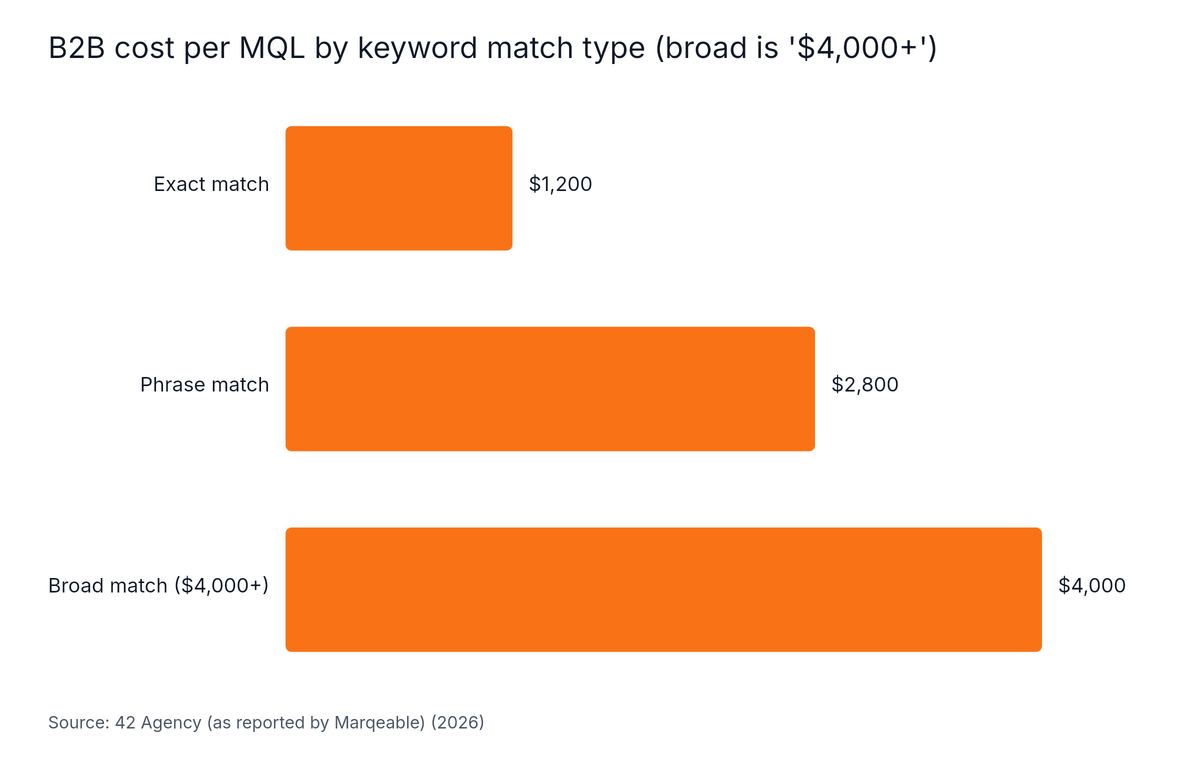
Source: 42 Agency (as reported by Marqeable), 2026
A negative keyword is a term that stops an ad from showing on any search containing it. Without negatives, broad match spends on whatever Google judges close enough. 42 Agency's B2B export data, reported by Marqeable, shows cost per marketing-qualified lead (MQL) of $1,200 on exact match, $2,800 on phrase and $4,000+ on broad (Marqeable, 2026). That is agency data with no sample size given, so read it as directional.
Sourced benchmark data: Broad match without negative keywords and PMax without offline conversions together account for 56% of documented Google Ads waste (The 2026 B2B SaaS Google Ads Waste Report, GrowthSpree, June 2026). Sample: 104 accounts, $78.0M in spend audited. Limitation: a convenience sample of audited accounts, not a random draw of all B2B SaaS advertisers.
Conversion signals matter just as much. Frederick Vallaeys of Optmyzr put it plainly: "Without conversion value data to guide Smart Bidding, the algorithm has less to work with" (Optmyzr, 2026).
Wasted clicks also cost more than they did. B2B non-branded Google Search CPC rose about 29%, from $4.13 in August 2024 to $5.34 in July 2025, while CTR fell about 26% to 4.04% (Dreamdata, 2025). Dreamdata described the result as "Fewer clicks (CTR -26%), higher costs (CPC +29%), and results that feel more unpredictable" (Dreamdata, 2025).
Three tools spot and fix wasted Google Ads spend fastest inside a quarter: the search terms report with negative keyword lists, offline conversion import through the Data Manager API, and an invalid-click detector. Google says advertisers who connect offline and app data see a 26% average increase in incremental return on ad spend (ROAS) (B2Blast, quoting Google, 2026).

For how ROAS fits B2B SaaS, see the explainer on what ROAS means for paid media. Google's figure is a first-party claim and needs careful reading.
The search terms report is the fastest free detector. Export it, sort by cost, and flag terms with clicks and no SQL. Query behaviour also drifts. The share of impressions from 1-2 word queries fell from 42% in January 2025 to 24% in August 2026, while 3-4 word queries rose from 33% to 48% (Search Engine Land, via Emarketed, 2026). Audits therefore need to repeat.
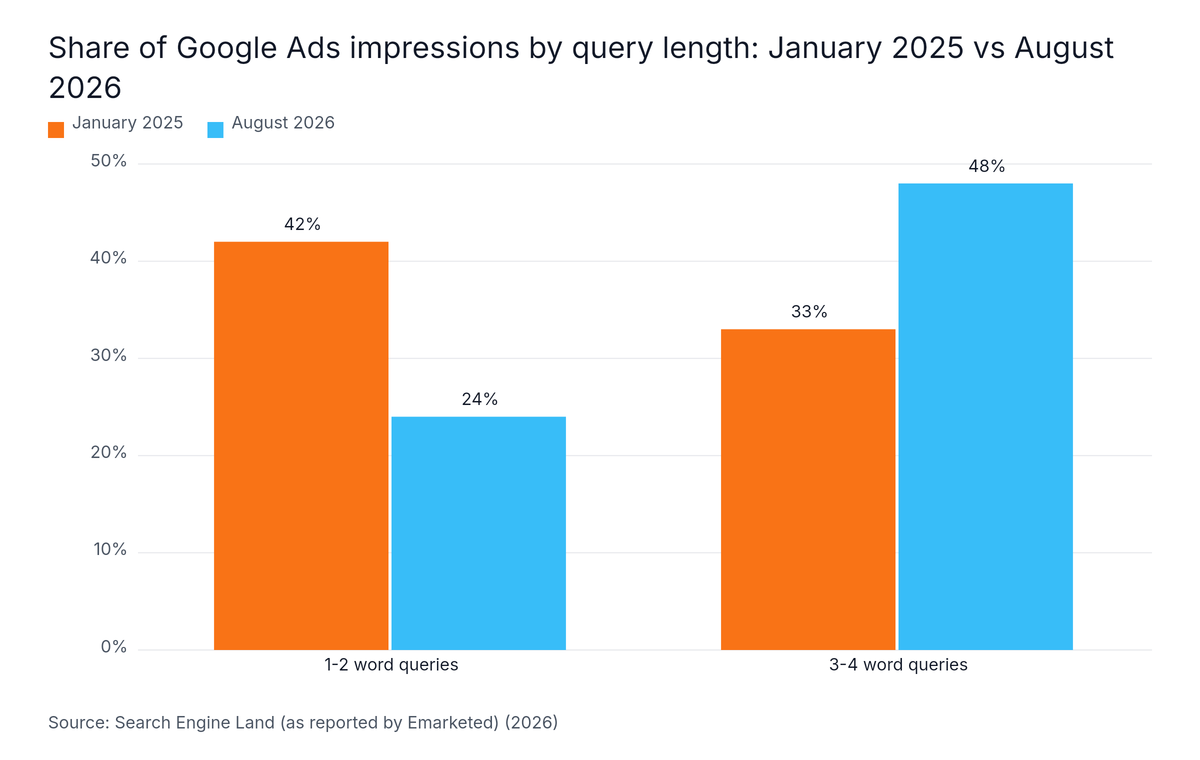
Source: Search Engine Land (as reported by Emarketed), 2026
Offline conversion import is the process of sending CRM outcomes such as SQLs and closed-won deals back to Google Ads, matched to the original click. Without it, bidding optimises toward form fills. The 2026 B2B SaaS Google Ads Waste Report (GrowthSpree, June 2026) found that 91% of audited accounts had no Google click ID (GCLID) connection to the CRM. PMax cost per SQL was $2,140 running blind versus $620 with offline conversions.
The plumbing changed in 2026. From 15 June 2026, Google moved offline conversion import and enhanced conversions for leads uploads to the Data Manager API. New imports through the Google Ads API were blocked for some developers (PPC Land, 2026). Search Engine Land advised affected teams to migrate workflows to the Data Manager API (Search Engine Land, 2026). The check is simple: compare SQLs in the CRM with conversions imported into Google Ads each week.
Two practical limits apply. Enhanced conversions for leads only import uploads made within 63 days of the click. Google's guidance is 15 or more events per 30 days for a stage to be a primary bidding goal (Zephra, 2026). The 63-day window is shorter than the 84-day median B2B SaaS sales cycle in the Waste Report, so late-stage outcomes may need a different import route. Verify both limits in Google Ads Help.
Invalid clicks are clicks that Google or a third party judges to come from bots, scripts or fraud rather than real buyers. Google's own Invalid Clicks column typically shows 2-5% of clicks, while third-party tools find about 11.5% (Spider AF, 2026). Fraud Blocker, another vendor, found an average invalid click rate of 11.4% (Fraud Blocker, 2026).
Lunio measured 7.57% invalid clicks on Google overall and 5.21% on Google Search, against 19.88% on LinkedIn (Lunio, via YouTarget, 2026).
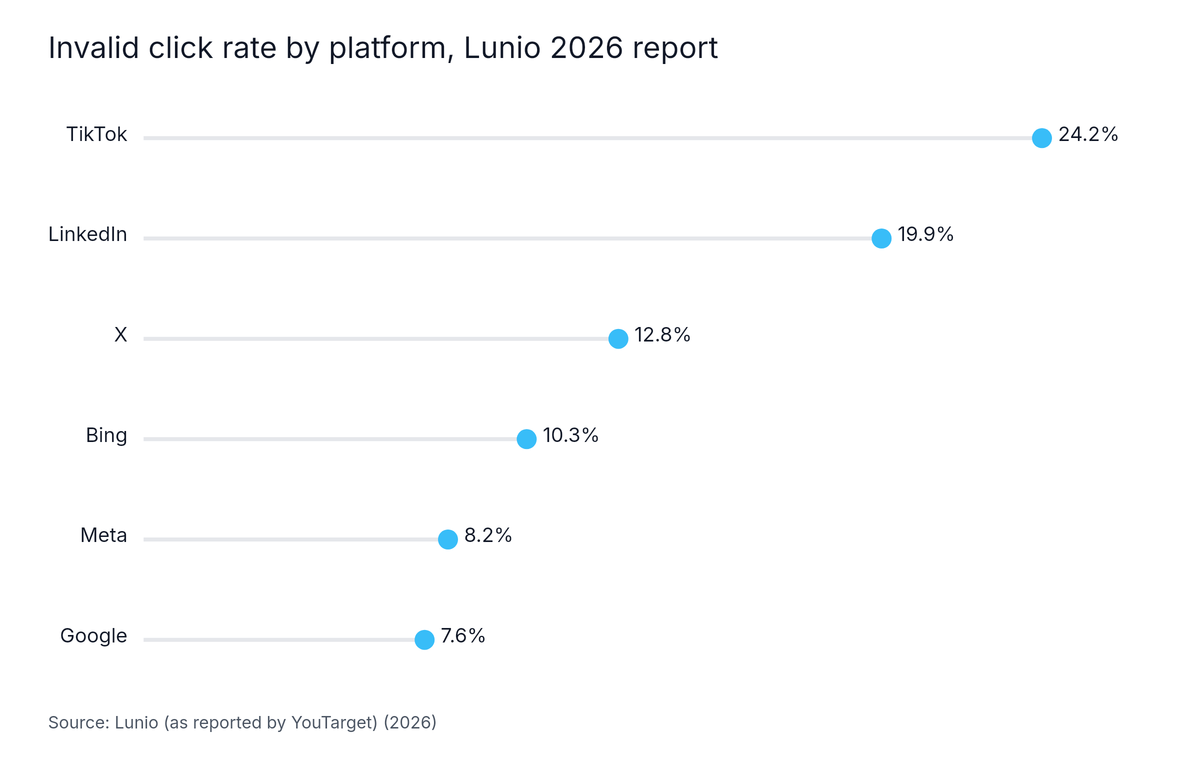
Source: Lunio (as reported by YouTarget), 2026
These invalid-click figures come from vendors, are not B2B-specific, and vary widely by who counts. Treat detection software as a second opinion on Google's filters, not as the first fix.
For a B2B SaaS account above a 30% waste rate, start with the search terms report sorted by cost, then add negatives, then fix offline conversions, then review match types and AI Max, then add invalid-click detection. Across 32 accounts, the most expensive 10% of zero-conversion terms held a median 48.8% of wasted spend (Doctor Ads, 2026).

Waste concentration in head terms is why order matters. The study covered 32 accounts and 5,244,638 zero-conversion terms, with reporting windows mostly from September 2024 to January 2025. A vendor published it, so read it as directional.
A 30% waste rate is a triage threshold, not a quartile claim. In an independent Q3 2026 sample, the middle 50% of accounts sat between 23.9% and 34.6%. That puts 30% near the median, not clearly in the worst quartile (Conner Crowe, 2026). Definitions differ between studies, so compare like with like.
| Measure | Figure | Sample and date |
|---|---|---|
| Average Google Ads waste rate | 34.0% | 104 B2B SaaS accounts, $78.0M spend, June 2026 |
| Best and worst quartile | 13.2% and 49.8% | Same study |
| Median visible search-term waste | 30.7% (middle 50%: 23.9% to 34.6%) | 25 accounts, Q3 2026, Conner Crowe |
| Average waste after a 90-day fix | 11.0% | Same 104-account study |
Sample and limits: the first, second and fourth rows come from The 2026 B2B SaaS Google Ads Waste Report (GrowthSpree, June 2026), a convenience sample of audited accounts. The third row is a small single-practitioner sample counting only search-term spend Google made visible.
Sourced benchmark data: A 90-day fix moved average Google Ads waste from 34.0% to 11.0% and cut cost per SQL by 62% (The 2026 B2B SaaS Google Ads Waste Report, GrowthSpree, June 2026). Sample: 104 accounts, $78.0M in spend audited. Limitation: results come from audited accounts that chose to be audited, so they may not match every account.
Next step: Meet with an expert. Free consultation. Bring your ad account questions and brainstorm with a paid media expert.
For a full audit sequence, see the B2B SaaS ad account audit checklist.
The Google Ads search terms report is not enough on its own, because it shows only part of spend. In 11 accounts with complete search-term pulls, the visible terms covered a median of only 52% of account spend (Conner Crowe, 2026). Waste figures built on that report therefore describe the visible part only.

The range in that sample ran from 20% to 71% visible. Google Ads Liaison Ginny Marvin said that "the threshold increase was solely privacy-driven" (Search Engine Roundtable, 2025). The sample is small and comes from one practitioner. The practical point holds: a clean report does not prove clean spend. Pair it with match-type cost per SQL and CRM data. The paid search guide for B2B SaaS covers the wider setup.
Performance Max (PMax) is a Google Ads campaign type that serves ads across Google channels from a single budget and set of assets. It now has native search term reporting and channel performance reporting (KeywordNinja, 2026), so first-party visibility has improved. Independent monitoring still matters because the platform also sells the automation. Google's claimed AI Max uplift moved from a 14% launch figure to 7% in April 2026, then to 15% on the July 22, 2026 earnings call, on different baselines (PPC Land, 2026).
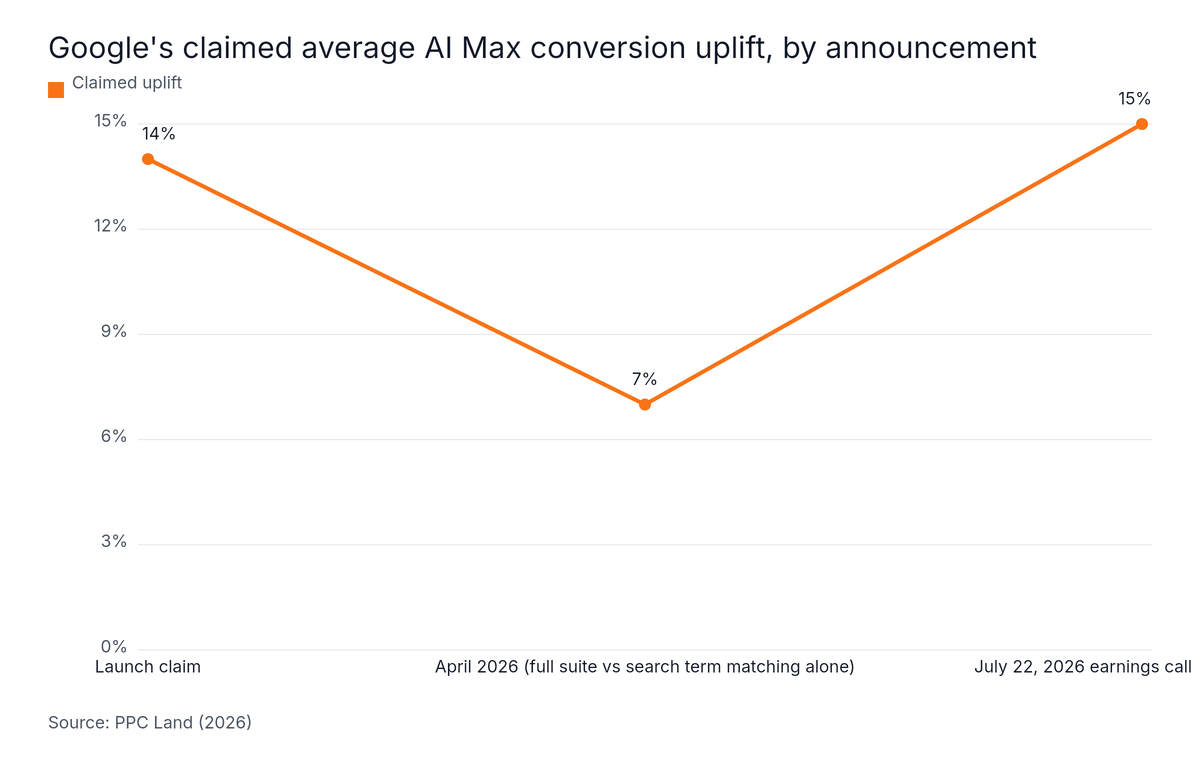
Source: PPC Land, 2026
Early practitioner tests were harsher. Monks' Ezra Sackett reported across about 30,000 AI Max search terms that "99% of impressions have 0 conversions" (PPC Land, 2025). That was a single early test, not a controlled study. Lead gen accounts on broad match with Smart Bidding are the most exposed, so weekly query review is the safer default.
The Best Picks list of tools to detect wasted ad spend in Google Ads is not for teams that want ranked software brands, pricing or hands-on test scores. It groups Google-native features by the waste signal each exposes, and it allows for a hard limit: visible search terms covered a median of only 52% of spend in one 11-account sample (Conner Crowe, 2026).

The Google Ads search terms report with negative keyword lists, offline conversion import and invalid-click detection software spot and fix most wasted Google Ads spend within a quarter. Start with search terms sorted by cost: across 32 accounts, the most expensive 10% of zero-conversion terms held a median 48.8% of wasted spend (Doctor Ads, 2026).
For a waste rate above 30%, the search terms report sorted by cost and a maintained negative keyword list cut wasted Google Ads spend fastest. Offline conversion import comes next, because PMax cost per SQL was $2,140 running blind versus $620 with offline conversions connected (The 2026 B2B SaaS Google Ads Waste Report, GrowthSpree, June 2026).
Avoid wasted ad spend in Google Ads by maintaining negative keywords, choosing match types deliberately, sending SQL and closed-won data back as offline conversions, and reviewing PMax and AI Max query reports on a schedule. Exact match lost 9.5% of spend share between 2022 and 2026, so negatives need regular upkeep (Optmyzr, 2026).
Calculate wasted ad spend percentage by dividing spend on zero-conversion terms by total spend, then repeat the calculation against SQL or pipeline events instead of form fills. In a Q3 2026 sample of 25 accounts the median was 30.7% of visible search-term spend, and visible terms covered only part of account spend (Conner Crowe, 2026).
The June 2026 Data Manager API change may have broken CRM uploads to Google Ads for some developers. From June 15, 2026 Google moved offline conversion import and enhanced conversions for leads uploads to the Data Manager API and blocked them in the Google Ads API. Compare SQL counts in the CRM with imported conversion counts to check (Search Engine Land, 2026).
Finding wasted spend in B2B SaaS Google Ads comes down to matching the tool to the signal. The main takeaways:
The next step is to run the five-step triage on one account this week, using the ad account audit checklist, and record the waste rate before and after. For the lead quality side, the PPC lead generation guide shows what good looks like.
Written by
Ishan Manchanda
Ishan Manchanda is co-founder of GrowthSpree, a B2B SaaS marketing consultancy founded in 2017 that has managed $60M+ in ad spend across 300+ B2B SaaS companies. He focuses on demand generation, go-to-market strategy and pipeline growth, and has been featured in Silicon Valley Times, SaaS Mag and the Unbounce podcast.
© 2026 adsforb2bsaas.com All rights reserved.