Blog
Offline Conversion Tracking for B2B SaaS: How It Works and Why the Default Setup Fails
Offline conversion tracking sends CRM pipeline back to ad platforms. Learn how the GCLID loop closes, what to set up first, and why 7-day attribution fails.
Median B2B SaaS non-brand CPC is $8.50 - $14.00, but varies 2.4× by vertical. Learn how search engine ads are priced and when SEO beats paid search.

Offline conversion tracking sends CRM pipeline back to ad platforms. Learn how the GCLID loop closes, what to set up first, and why 7-day attribution fails.
Learn how to reduce wasted ad spend in B2B SaaS: causes, a waste rate formula, quartile benchmarks and a prioritised fix list that keeps total budget.

Why ad platform conversions and CRM pipeline never match in B2B SaaS: attribution windows, form fills that miss SQL, a GCLID audit and a fix sequence.
Request a quote and our experts will contact you within 24 hours with tailored solutions and pricing.
adsforb2bsaas.com
Last updated: Oct 19, 2026
By Ads for B2B SaaS Editorial Team | Last updated: October 13, 2026
Search engine ads for B2B SaaS are auction-based pay-per-click placements on Google and Bing, priced through a real-time relevance auction, with non-brand costs running $8.50 to $14.00 per click for most verticals and a waste rate averaging 34.0% across audited accounts.
Most B2B SaaS marketing teams inherit a Google Ads account rather than build one, with no clear view of whether the current cost per click is appropriate for their vertical. The median non-brand cost per click runs $8.50 to $14.00, but that range hides a 2.4x spread by vertical, a 4x gap between brand and non-brand terms, and attribution defaults that leave the majority of pipeline invisible to the platform. Whether a given CPC is good or terrible depends on the vertical, the annual contract value (ACV), and whether the account is set up to capture a sales cycle that typically runs 84 days.
This guide covers how search engine ads work and how they are priced, what good numbers look like by vertical, how paid search fits a long-cycle B2B go-to-market, where hidden waste comes from, and when organic search is the more defensible bet.
Key Takeaways
- Median B2B SaaS non-brand search CPC is $8.50 to $14.00, but Cybersecurity reaches $18.00 and DevTools sits at $7.50-the same budget buys very different outcomes by vertical (GrowthSpree, B26, April 2026).
- Non-brand keywords cost roughly 4x more per click than brand terms ($13.75 vs $3.12 in active accounts), making brand campaign efficiency a meaningful budget lever (Pipe Rocket Digital, 2026).
- Default 7-day Google Ads attribution captures only 5% to 15% of revenue for B2B SaaS companies with an 84-day median sales cycle, meaning most accounts are flying blind on pipeline contribution (GrowthSpree, G26, June 2026).
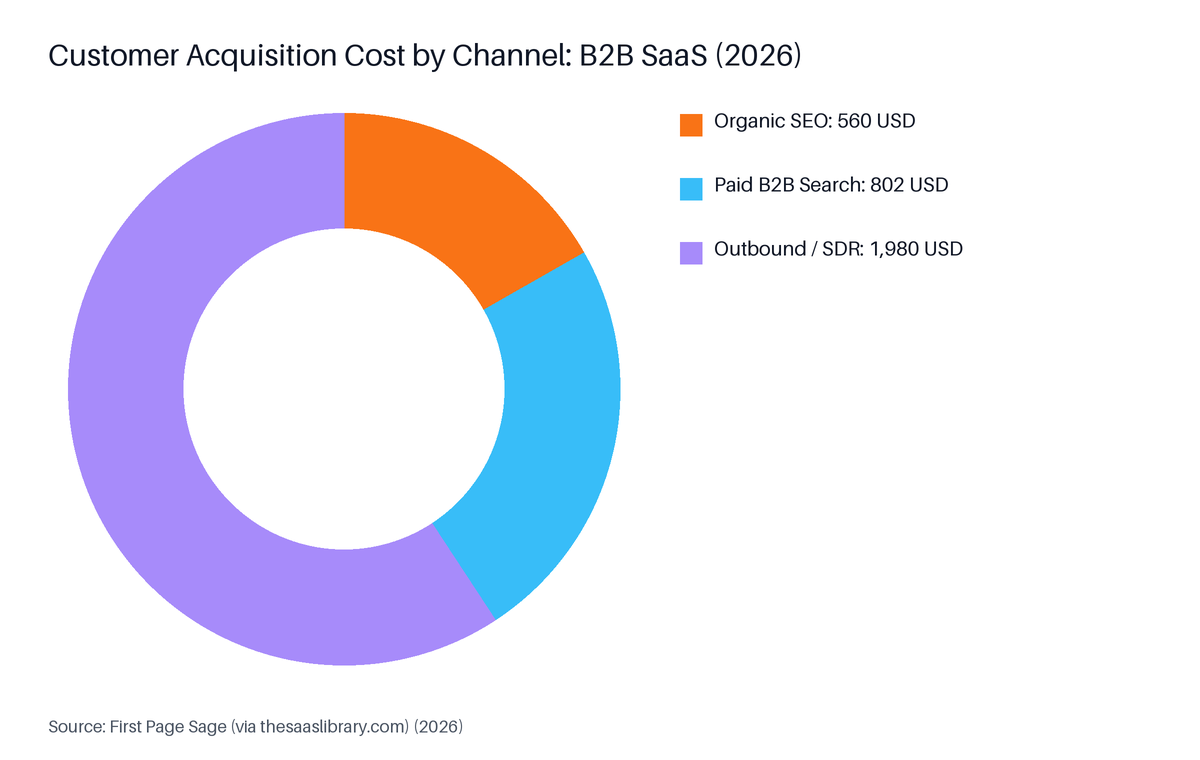
- Organic SEO delivers an average customer acquisition cost of $560 versus $802 for paid search, and SEO-sourced leads convert from MQL to SQL at nearly twice the rate-51% versus 26% (First Page Sage data, via thesaaslibrary.com and reactin.io, 2026).
- Cost per SQL - not CTR or cost per lead - is the metric that predicts pipeline: correlation with pipeline is r=0.71 for cost per SQL versus r=0.09 for CTR across 1,412 ad variants (GrowthSpree, PD26, June 2026).
Search engine ads are auction-based placements above organic results, priced per click through a real-time relevance auction that weighs each bid against a Quality Score. For B2B SaaS, non-brand keywords average $13.75 CPC versus $3.12 for brand terms - a roughly 4x premium (Pipe Rocket Digital, 2026). The auction runs on every search, so actual cost reflects both bid level and account relevance, not bid alone.

Quality Score is Google's 1-10 rating of the relevance of an ad, keyword, and landing page - it determines ad rank and the actual cost per click in every auction. Every time a user searches, Google runs a private auction. Advertisers submit a maximum bid; Google multiplies that bid by the Quality Score to produce Ad Rank, the calculated position value that determines where an ad appears. The advertiser with the highest Ad Rank wins the top position but pays only slightly more than the next bidder, not their maximum bid. A highly relevant ad can beat a higher-bid competitor and pay less per click.
For B2B SaaS specifically, three factors shape what each click costs:
The cross-industry average Google Ads CPC reached $5.26 in 2025, up 12.88% year-over-year - the fifth consecutive year of cost increases (WordStream, 2025). Aggregate all-industry data consistently understates what B2B SaaS teams pay: technology and SaaS CPCs in blended industry datasets run $1.70 to $3.80 (TerraHQ, 2026), far below active B2B SaaS account averages, because those datasets blend branded, display, and low-intent traffic with high-intent search.
Not all paid search campaigns carry the same price. The blended average CPC across all Google Ads campaign types in B2B SaaS is $6.81, with Search-only campaigns averaging $11.02 CPC - versus $0.75 for Performance Max (PMax) and $0.68 for Display (Pipe Rocket Digital, 2026). The difference reflects reach and intent: Search targets active query intent; Performance Max and Display serve placements across Google's broader inventory.
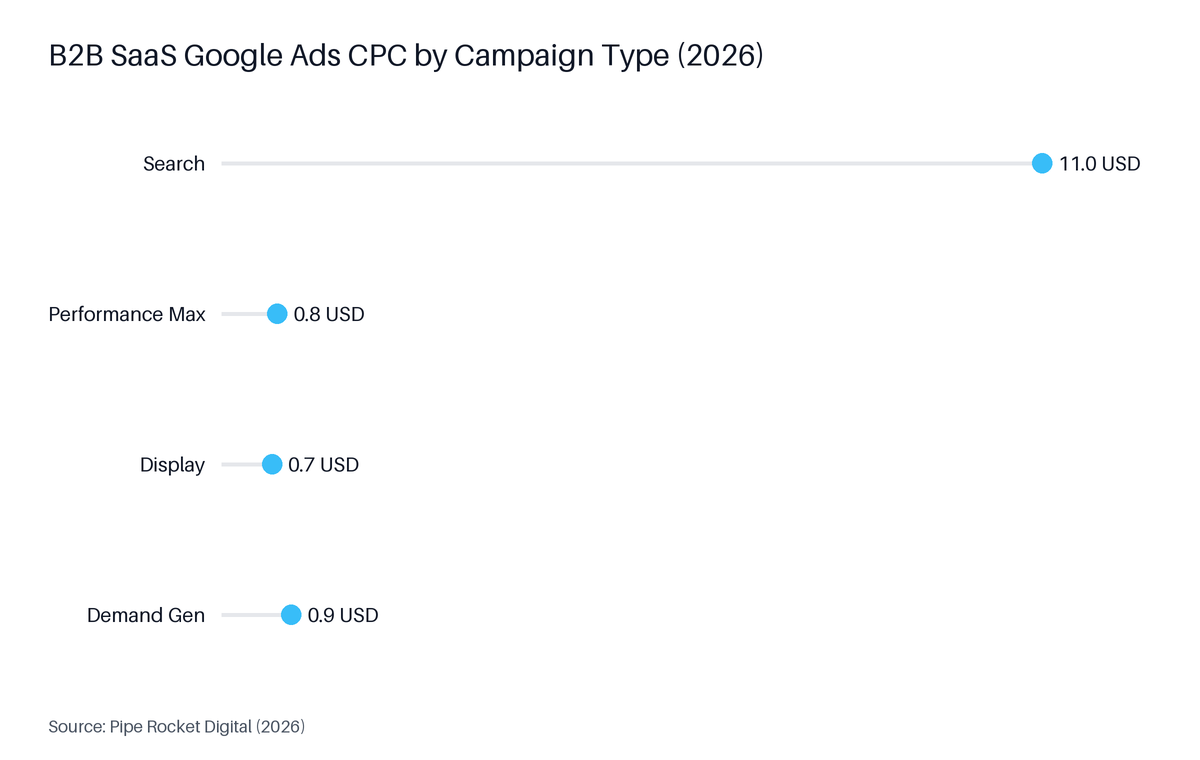
Source: Pipe Rocket Digital, 2026
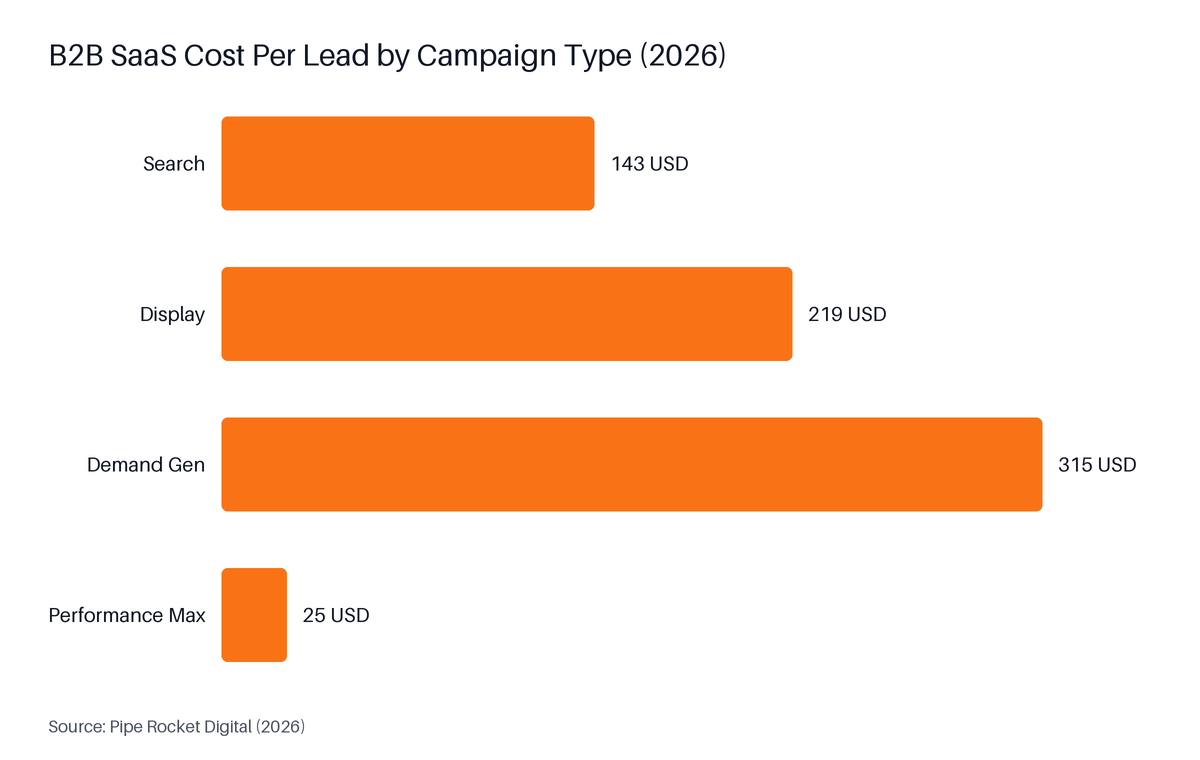
Performance Max (PMax) is a Google Ads campaign type that uses machine learning to serve ads across all Google inventory - Search, Display, YouTube, Gmail, and Maps - from a single campaign. Its $25 cost per lead is the lowest of any campaign type (Pipe Rocket Digital, 2026), but that figure blends branded and low-intent placements. Without the right offline conversion signals, PMax optimises toward whatever is easiest to convert, not toward sales-qualified leads (SQLs).
The median B2B SaaS non-brand cost per click runs $8.50 to $14.00, but vertical spread is wide: DevTools sits at $7.50 CPC while Cybersecurity reaches $18.00 (GrowthSpree, B26, April 2026). Cost per SQL ranges from $650 in DevTools to $3,500 in Cybersecurity. Technical SaaS verticals average a cost per lead of $855-roughly 6.8x higher than GTM and MarTech at $126 (Pipe Rocket Digital, 2026).

The table below summarises sourced benchmark data for B2B SaaS verticals. All figures come from convenience samples - not population data - and should be treated as directional references.
| Vertical | Non-brand CPC | Cost per SQL | Source |
|---|---|---|---|
| DevTools / Developer | $7.50 | $650 | GrowthSpree, B26, Apr 2026 |
| Cybersecurity | $18.00 | $3,500 | GrowthSpree, B26, Apr 2026 |
| Median B2B SaaS (all verticals) | $8.50 - $14.00 | $800 - $2,500 | GrowthSpree, B26, Apr 2026 |
| Technical SaaS (dev tools, security) | - | CPL $855 | Pipe Rocket Digital, Aug 2026 |
| GTM and MarTech | - | CPL $126 | Pipe Rocket Digital, Aug 2026 |
Across eight B2B SaaS verticals, CPCs range from $7.50 (DevTools) to $18.00 (Cybersecurity). The full vertical spread, per Marqeable 2026 benchmarks: Project Management $9.00, HR Tech $11.50, ERP / Operations $12.00, MarTech / Sales Tech $13.00, Healthcare Tech $14.50, and FinTech / Payments $16.00.
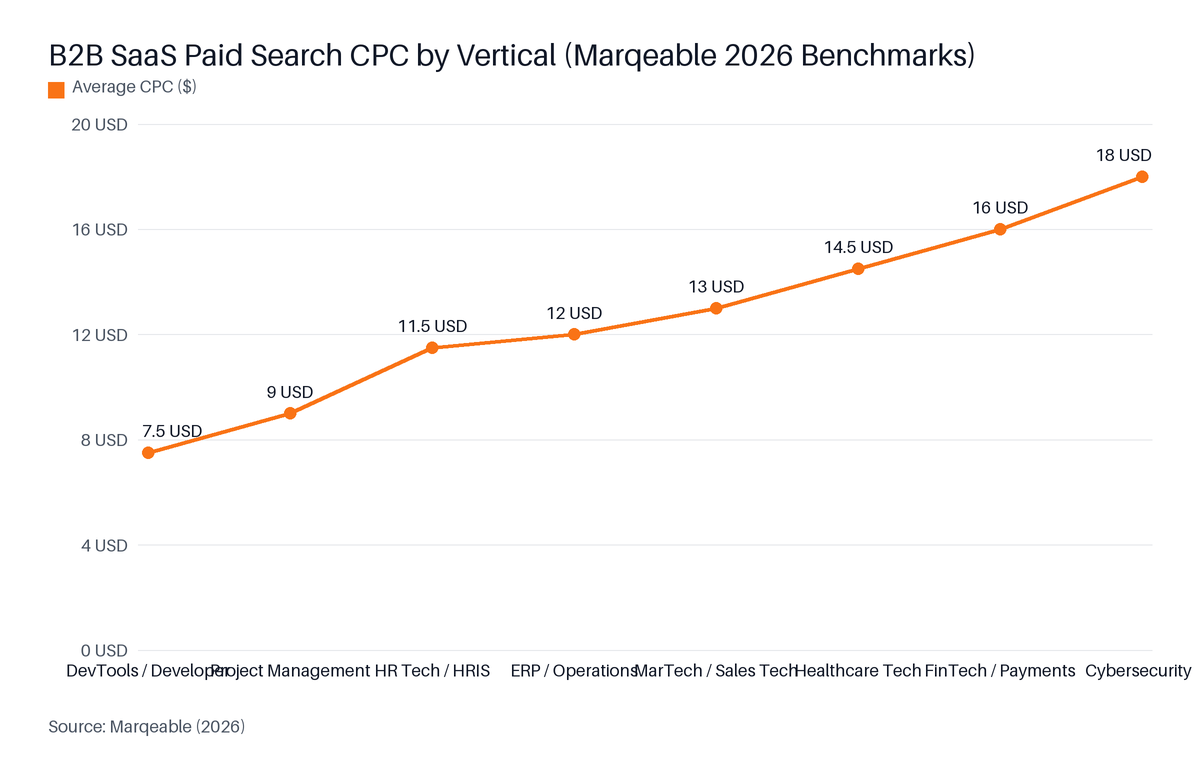
Source: Marqeable, 2026
Sourced benchmark data: The 2026 B2B SaaS Google Ads Waste Report (GrowthSpree, G26, June 2026) covered 104 B2B SaaS accounts and $78.0M in audited spend. The average waste rate across those accounts was 34.0% - approximately $255,000 per account per year. The best-quartile accounts wasted 13.2%; the worst-quartile accounts wasted 49.8%. That gap reflects account structure and settings, not vertical difficulty alone.
The gap between brand and non-brand keyword costs is one of the most actionable budget decisions in B2B SaaS paid search. Non-brand keywords averaged $13.75 CPC versus $3.12 for brand terms in active accounts, per Pipe Rocket Digital's 24-month dataset covering July 2024 through June 2026 (Pipe Rocket Digital, 2026). Protecting brand terms is cheap. Competing for non-brand category terms is expensive. Allocating budget between the two is a first-order decision, not an optimisation detail.
Performance Max's $25 cost per lead looks attractive next to Search's $143 CPL (Pipe Rocket Digital, 2026). The gap reflects that PMax serves many more impressions across low-intent placements. For B2B SaaS, cost per lead is less useful than cost per SQL - the total paid media spend divided by the number of sales-qualified leads produced. The distance between those two figures is substantial: 78% of form fills never reach SQL status (GrowthSpree, G26, June 2026). A cheap lead that never becomes an SQL is not a lead worth counting.
Source: Pipe Rocket Digital, 2026
Paid search for B2B SaaS is a demand-capture channel that reaches buyers already searching for a solution. It works best at the bottom of the funnel: brand keywords, competitor terms, and high-intent category queries. With a median sales cycle of 84 days and buying committees of 6 to 10 people, it must be paired with CRM-based attribution-91% of audited accounts had no Google click ID (GCLID)-to-CRM connection (GrowthSpree, G26, June 2026).

Ideal customer profile (ICP) is a detailed description of the company type and buyer persona most likely to purchase and retain a SaaS product. Paid search reaches individuals within the ICP who are actively searching - a smaller slice than most teams assume, because B2B buyers spend the majority of their research time reading content rather than running queries with commercial intent.
The table below maps where paid search earns its budget in a B2B SaaS go-to-market, versus where other channels are better suited.
| Funnel Stage | Paid Search Role | Better Alternative |
|---|---|---|
| Problem unaware | Ineffective - no search intent | Thought leadership, LinkedIn Ads |
| Category aware, not searching | Weak - low search volume | LinkedIn Ads, YouTube Ads |
| Actively comparing solutions | Strong - high-intent keywords | Google Ads Search campaigns |
| Brand recall and re-engagement | Strong - brand terms, low CPC | Remarketing, brand campaigns |
| Long sales cycle nurture (days 30-84) | Weak - attribution window mismatch | CRM sequences, LinkedIn retargeting |
Annual contract value (ACV) is the average yearly revenue value of a customer contract, used to assess how much a company can sustainably spend to acquire a customer. At a Cybersecurity CPC of $18.00 and a cost per SQL of $3,500, with a 19% average B2B opportunity-to-closed-won win rate (Ebsta x Pavilion, via reactin.io, 2026), the implied cost per acquired customer from paid search exceeds $18,000. That math only works when ACV is substantially higher.
As Right Left Agency's 2026 analysis put it: "Fund paid search first when the immediate need is qualified pipeline and the company still needs to validate demand, messaging, or acquisition economics" (Right Left Agency, 2026).
For lower-ACV SaaS products, auction economics push cost per SQL past payback thresholds faster. The ACV-to-CPC ratio matters more than the CPC number in isolation.
Default attribution is the most common culprit. Google Ads defaults to a 7-day click window, capturing only 5% to 15% of revenue for companies with an 84-day median sales cycle (GrowthSpree, G26, June 2026). Meanwhile, 78% of form fills never reach sales-qualified lead (SQL) status - a prospect the sales team has assessed as meeting the criteria to enter an active sales process. Broad match without negative keywords and Performance Max without offline conversions account for 56% of documented Google Ads waste (GrowthSpree, G26, June 2026).
Source: First Page Sage (via thesaaslibrary.com), 2026
Across 1,412 ad variants, 96 accounts, and $14.2M in spend, click-through rate (CTR) correlated with pipeline at r=0.09-essentially no relationship. Cost per SQL correlated with pipeline at r=0.71 (GrowthSpree, The Paid Ads Pipeline Disconnect, PD26, June 2026). In 43% of A/B tests, the higher-CTR ad produced fewer or costlier SQLs. Re-scoring and reallocating budget by cost per SQL improved cost per SQL by approximately 44% with no extra spend.
The practical implication: an account optimising on CTR and cost per lead routinely directs budget toward ads that produce form fills rather than ads that produce pipeline. Those two outcomes are not the same in B2B SaaS.
The 2026 B2B SaaS Google Ads Waste Report (GrowthSpree, 104 accounts, $78.0M spend, June 2026) found an average waste rate of 34.0% - approximately $255,000 per account per year. The best quartile wasted 13.2%; the worst wasted 49.8%. The two biggest structural drivers:
A 90-day structural fix moved average waste from 34.0% to 11.0% and cut cost per SQL by 62% (GrowthSpree, G26, June 2026).
Paid search beats SEO when speed matters: a new product, a new market, or urgent pipeline that cannot wait 12 to 18 months for organic content to rank. SEO wins on long-run economics: organic customer acquisition cost averages $560 versus $802 for paid search (First Page Sage, via thesaaslibrary.com, 2026). SEO-sourced MQL-to-SQL conversion rates run 51% versus 26% for paid search leads (First Page Sage, via reactin.io, 2026), making organic more defensible past the validation stage.

As Flighted's 2026 benchmark analysis noted: "Paid search captures high-intent traffic, but CPCs in B2B SaaS run expensive. This channel works best for bottom-funnel capture rather than demand creation" (Flighted, 2026).
Customer acquisition cost (CAC) is the total marketing and sales spend divided by the number of new customers acquired in the same period - a measure of channel efficiency beyond cost per lead. The quality gap extends beyond CAC:
These differences reflect intent. Someone who found a vendor through months of organic research is further along in the buying journey than someone who clicked an ad at a single moment of in-market intent. Paid search captures that moment; organic content can influence buyers throughout the research process.
| Scenario | Paid Search | SEO |
|---|---|---|
| Need pipeline in 30-90 days | Yes | No |
| Validating product-market fit | Yes | No |
| Entering a new market or region | Yes | Slower |
| High search volume for category terms | Yes | Yes (over time) |
| Very high CPC relative to ACV | No | Yes |
| Long-run CAC efficiency | No | Yes |
| Building traffic that survives budget cuts | No | Yes |
| Low search volume (buyers unaware of category) | No | No (both weak) |
"Paid search does not get cheaper with scale; it usually gets more expensive as you move out from your cheapest keywords" (Distribb, 2026). The cheapest brand terms fill quickly; non-brand expansion means higher CPCs, broader match types, and lower average intent. Median B2B SaaS customer acquisition cost has reached $2.00 per $1.00 of new ARR - up 14% from 2023-with bottom-quartile companies spending $2.82 per dollar of ARR (Benchmarkit 2025, via olivermunro.com, 2026). In that environment, paid search costs that do not convert to pipeline compound into a serious payback problem.
B2B SaaS paid search requires the Google click ID (GCLID) captured in the CRM at form submission, with SQL and closed-won data imported back to Google as offline conversions. Without this setup, Performance Max cost per SQL reached $2,140; with offline conversions connected, it fell to $620-a 71% reduction with no extra spend (GrowthSpree, G26, June 2026). The attribution window should match the actual sales cycle, typically 90 days or more for most B2B SaaS companies.
89% of audited accounts ran default attribution before their audit (GrowthSpree, G26, June 2026). The default 7-day click attribution window was built for ecommerce and short-cycle purchases, where conversion happens hours or days after the click. In B2B SaaS, with an 84-day median sales cycle and buying committees of 6 to 10 people, the buyer who clicked an ad in month one may not reach contract stage until month three. The platform never sees that revenue, so its bidding algorithm has no signal that the click mattered.
Offline conversions are CRM events - such as SQL creation or closed-won deals - imported back into Google Ads via the GCLID so the bidding algorithm optimises on real business outcomes rather than platform-visible form submissions.
| Stage | Conversion Volume | Recommended Strategy |
|---|---|---|
| Account setup or new campaign | Fewer than 15 offline events/month | Manual CPC or Max Clicks |
| Building signal | 15-30 offline events/month | Max Conversions |
| Target CPA viable | 30-50 offline events/month | Target CPA |
| ROAS optimisation | 50+ offline events/month with revenue values | Target ROAS |
Paid search is a poor primary growth channel for B2B SaaS companies where buyers do not yet know a solution category exists and search volume is near zero. It also underperforms when CPC is high relative to annual contract value (ACV): Cybersecurity at $18.00 CPC and $3,500 cost per SQL demands a high ACV to pay back. Companies in early demand creation or below a viable cost-per-SQL threshold face a structural payback problem.
This is not an argument against paid search as a long-term channel. It is an argument that paid search earns its budget when there is demonstrable search demand, a viable ACV-to-CAC ratio, and attribution infrastructure that closes the loop to the CRM.
Paid search for B2B SaaS is a demand-capture channel, not a demand-creation one. It reaches buyers actively searching for a solution, making it most effective on brand terms, competitor terms, and high-intent category queries. With a median sales cycle of 84 days and buying committees of 6 to 10 people, paid search must be paired with CRM-based attribution to accurately show pipeline contribution.
Paid search wins when speed matters: a new product, a new region, or urgent pipeline validation. SEO wins over time: organic customer acquisition cost averages $560 versus $802 for paid search, per First Page Sage data compiled in 2026 (via thesaaslibrary.com). SEO-sourced leads also convert from MQL to SQL at 51% versus 26% for paid search, making organic more efficient for companies past the validation stage.
The median B2B SaaS non-brand cost per click runs $8.50 to $14.00, per the SaaS Google Ads Benchmarks 2026 report (GrowthSpree, April 2026). Verticals vary significantly: DevTools averages $7.50 CPC and Cybersecurity averages $18.00. Brand terms cost far less - around $3.12 CPC versus $13.75 for non-brand terms in active accounts (Pipe Rocket Digital, 2026), a roughly 4x premium for non-brand keywords.
The median B2B SaaS cost per SQL from paid search runs $800 to $2,500, with wide variation by vertical (GrowthSpree, B26, April 2026). DevTools accounts average $650 per SQL; Cybersecurity accounts average $3,500. Attribution setup matters: Performance Max accounts with offline conversions connected achieved $620 per SQL, versus $2,140 for accounts running without that data (GrowthSpree, G26, June 2026).
No. Across 1,412 ad variants, 96 accounts, and $14.2M in spend, click-through rate correlated with pipeline at r=0.09-essentially no relationship. Cost per SQL correlated with pipeline at r=0.71 (GrowthSpree, PD26, June 2026). In 43% of A/B tests, the higher-CTR ad produced fewer or costlier SQLs. Optimising on CTR actively misdirects budget away from ads that produce pipeline.
Google Ads defaults to a 7-day click attribution window. With a median B2B SaaS sales cycle of 84 days, that window captures only 5% to 15% of actual revenue (GrowthSpree, G26, June 2026). The correct setup involves capturing the GCLID in the CRM, then importing closed-won and SQL data as offline conversions using a window matched to the actual sales cycle - typically 90 days or more.
Performance Max delivers a reported $25 cost per lead - the lowest of any Google Ads campaign type (Pipe Rocket Digital, 2026). However, that figure blends branded and low-intent placements, making the headline CPL misleading for pipeline quality assessment. Without offline conversions connected, PMax cost per SQL reached $2,140 versus $620 with proper signals (GrowthSpree, G26, June 2026). PMax can work when offline conversion data feeds the algorithm accurate quality signals.

Search engine ads for B2B SaaS are priced through a real-time auction that favours relevance as much as spend. The median non-brand CPC runs $8.50 to $14.00; brand terms cost roughly 4x less. Cost per SQL ranges from $650 in DevTools to $3,500 in Cybersecurity, making vertical context the first number to establish, not an afterthought.
Paid search earns its place as a demand-capture channel when three conditions are present: there is demonstrable search volume from buyers in the ICP, the ACV-to-cost-per-SQL ratio is viable, and attribution infrastructure captures the GCLID and imports offline conversions matched to the actual sales cycle. Without those conditions, 5% to 15% of revenue is all the platform will ever see (GrowthSpree, G26, June 2026), and the average account loses 34.0% of spend to settings that can be fixed.
SEO is not the opposite of paid search. Organic customer acquisition costs $560 against paid search's $802, and organic leads convert to SQL at nearly twice the rate-51% versus 26% (First Page Sage data, via thesaaslibrary.com and reactin.io, 2026). For companies past the validation stage, a longer-horizon organic investment is the more defensible bet. But the two channels address different buyer moments and can run in parallel once attribution is in place.
Ready to pressure-test your paid search setup against these benchmarks? Meet with an expert at Ads for B2B SaaS for a free consultation. Bring your account questions and brainstorm with a paid media expert.
All GrowthSpree studies cited in this guide are convenience samples, not population data, and should be treated as directional benchmarks. Full study details:
Sourced benchmark data. Every figure in this guide cites its study name, publisher, sample size, and date. Underlying datasets are convenience samples and should be used as directional references, not hard targets.
© 2026 adsforb2bsaas.com All rights reserved.