Request a quote and our experts will contact you within 24 hours with tailored solutions and pricing.
Paid Search for B2B SaaS Demand Capture: Structure Guide
By Ads for B2B SaaS Editorial Team. Last updated October 28, 2026.
B2B SaaS demand capture through paid search is the practice of reaching buyers who are already searching, using campaigns built so intent, match type and conversion signals filter out noise. Buyers are searching. The waste comes from how accounts are built. Across 104 audited B2B SaaS Google Ads accounts, broad match without negative keywords and Performance Max (PMax) without offline conversions together drove 56% of documented waste (GrowthSpree, June 2026). This guide covers the structure decisions that separate in-market buyers from noise before a dollar is spent. It pairs well with a guide to diagnosing wasted ad spend. Read on for a campaign layout, a negative keyword model and a pre-launch gate list.
Key Takeaways
A B2B SaaS paid search account works best split into brand, competitor, category and problem-aware campaigns, each with its own budget and negative list.
Broad match and Performance Max (PMax) are safe only after negative keywords and offline conversions are in place; together they drove 56% of documented Google Ads waste in a 104-account audit (GrowthSpree, June 2026).
Google moved AI Max for Search out of beta in 2026 and began migrating campaign-level broad match to it from September 2026, so structure now has to account for automation Google controls.
Cost per sales-qualified lead (SQL) tracked pipeline (r = 0.71) far better than click-through rate (r = 0.09), so B2B SaaS campaign decisions should be judged on SQLs (GrowthSpree, June 2026).
How should a B2B SaaS company structure paid search campaigns to reach in-market buyers?
A B2B SaaS paid search account should be split by intent into brand, competitor, category and problem-aware campaigns, each with its own budget, negative list and conversion goal. The split matters because broad match without negatives and Performance Max without offline conversions drove 56% of documented waste across 104 accounts (GrowthSpree, June 2026), against an 84-day median sales cycle.
Four labeled bins on a desk sorting search queries by buyer intent
Demand capture is reaching buyers who are already searching for a solution, rather than creating interest among buyers who are not. Structure decides how cleanly an account does that. The table below shows a common four-layer starting point. The match types are a practitioner starting point, not a measured optimum.
Campaign layer
Example searcher intent
Starting match type
Cross-negatives to add
Judge it on
Brand
Your company or product name
Exact
Competitor names, jobs, support terms
Cost per SQL, kept separate
Competitor
"[Rival] alternatives", "[Rival] vs"
Exact and phrase
Your brand terms, jobs, free
Cost per SQL
Category
"[category] software", "[category] platform"
Exact and phrase
"what is", "definition", "jobs"
Cost per SQL
Problem-aware
Symptom or task phrasing
Phrase, tightly themed
"pricing", "buy", brand terms
SQL rate from form fills
Why intent separation comes first
Separate campaigns give each intent its own budget cap, copy and landing page. They also stop a cheap research click from hiding an expensive buying click in a blended average. Average CPC on B2B non-branded Google Search reached $5.34 by July 2025 (Dreamdata, 2025), so every misdirected click is costly.
Define the ideal customer profile (ICP) before building. Firmographic limits belong in targeting, ad copy and the landing page, not only in the CRM. The Paid Search for B2B SaaS overview covers when search is the right channel at all.
Why does unfiltered paid search traffic waste so much B2B SaaS budget?
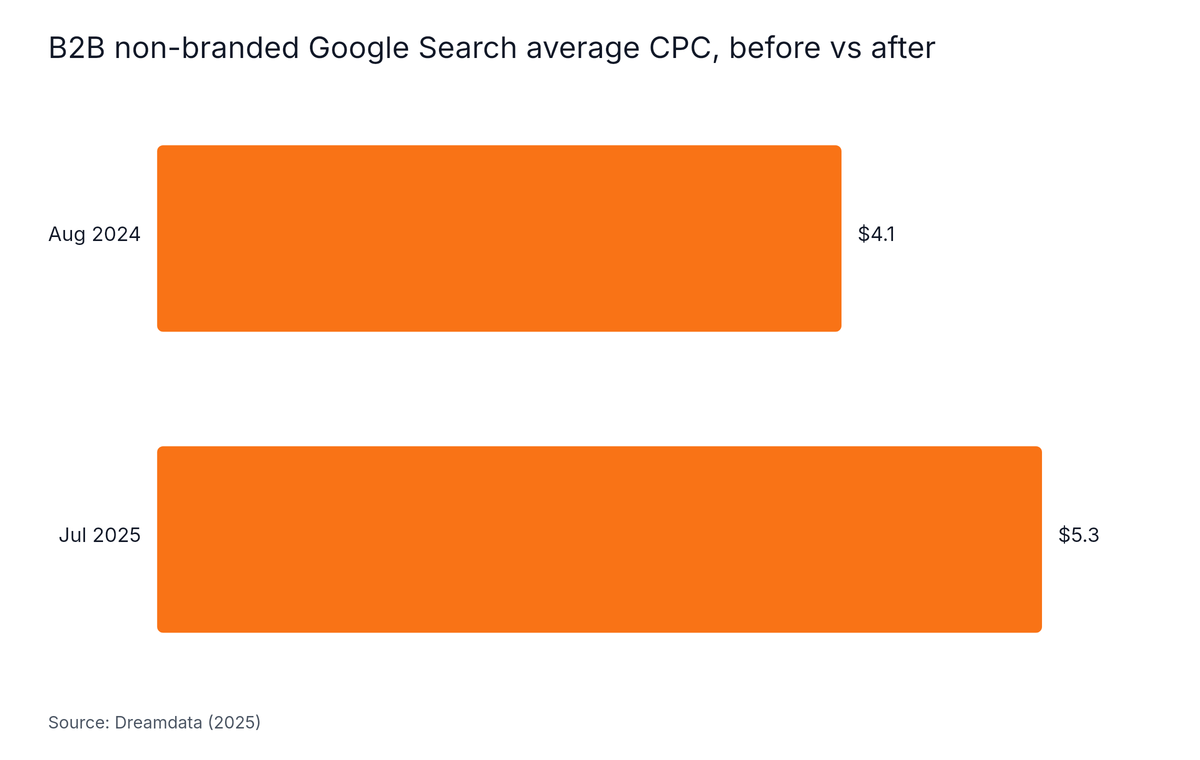
Unfiltered paid search traffic is getting more expensive while fewer clicks come from buyers. Dreamdata's benchmark found average CPC on B2B non-branded Google Search ads rose about 29% to $5.34 between August 2024 and July 2025. Click-through rate fell about 26% to 4.04% (Dreamdata, 2025). Each wasted click therefore costs more than before.
Horizontal Bar chart: B2B non-branded Google Search average CPC, before vs after. Highest: Jul 2025 at $5.3.
The chart shows average CPC rising from $4.13 in August 2024 to $5.34 in July 2025. Dreamdata's data comes from its B2B customers with a Google Ads integration and is not limited to SaaS. Non-branded Google Search also takes an average of 35.53% of B2B marketing budgets, second only to LinkedIn, so small efficiency changes move overall spend (Dreamdata, 2025).
What the waste looks like in B2B SaaS accounts
Waste rate is the share of ad spend that produced no qualified pipeline. The 2026 B2B SaaS Google Ads Waste Report audited 104 accounts and $78.0M in spend.
Sourced benchmark data: Average Google Ads waste rate was 34.0%, or about $255K of wasted spend per account per year. The best quartile wasted 13.2% and the worst quartile 49.8% (GrowthSpree, The 2026 B2B SaaS Google Ads Waste Report, 104 accounts, $78.0M spend, June 2026).
Measure
Value
Source
Average Google Ads waste rate
34.0%
GrowthSpree, June 2026
Average wasted spend per account per year
~$255K
GrowthSpree, June 2026
Best quartile waste rate
13.2%
GrowthSpree, June 2026
Worst quartile waste rate
49.8%
GrowthSpree, June 2026
Study: The 2026 B2B SaaS Google Ads Waste Report. Sample: 104 audited accounts, $78.0M spend, published June 2026. Limitation: the sampling method is not stated, so the figures describe those audits, not every B2B SaaS account.
Raising budget on a structure like the worst quartile only scales the waste. The ad account audit process shows what to fix first.
Should brand, competitor and non-brand campaigns be separate?
Brand, competitor and non-brand searches belong in separate campaigns because each carries different intent, cost and budget needs. Dreamdata's benchmark found branded Google Search CPC rose over 34% and CTR fell nearly 29% (Dreamdata, 2025). Branded search takes about 7% of customers' digital ad budgets, so blending it with non-brand hides what category capture really costs.
Three separate paths splitting from one road toward different destinations
Why non-brand capture needs a shortlist position
Forrester's 2024 Buyers' Journey Survey found 92% of buyers start with at least one vendor in mind, and 41% have a single preferred vendor before formal evaluation (Forrester via Digital Commerce 360, 2025). Forrester summarized it this way: "B2B buying today is a process of confirmation, not selection" (Forrester via Digital Commerce 360, 2025). A brand campaign protects the confirmation search. A category campaign only wins when the brand is already known.
Why competitor campaigns deserve their own budget
A Google survey of 2,063 senior U.S. business leaders found 58% of buyers who made a B2B purchase in the past six months also switched vendors (Google survey via Digital Commerce 360, 2025). The report's authors put it plainly: "Buyers no longer stay simply because it’s what they’ve always done" (Digital Commerce 360, 2025).
Google is a platform vendor with an interest in search, so treat the figure as directional. It still supports a live pool of competitor and alternatives searches. These need their own copy, landing pages and cost per SQL target.
Does broad match work for B2B SaaS, and what changed with AI Max in 2026?
Broad match is safe for B2B SaaS only after exact and phrase match campaigns, a shared negative keyword list and offline conversions are in place. Broad match without negative keywords and Performance Max (PMax) without offline conversions together account for 56% of documented Google Ads waste across 104 B2B SaaS accounts (GrowthSpree, June 2026).
A fine mesh sieve catching debris while clear water passes through
AI Max for Search is Google's automation layer for Search campaigns that widens targeting and creative beyond keywords, and it now replaces campaign-level broad match. Google says: "AI Max is moving out of beta, with improved performance quality across targeting and creative capabilities" (Google, 2026).
Google also reports 7% more conversions or conversion value on average, at a similar CPA or ROAS, for the full feature suite versus search term matching alone (Google, April 2026). That figure is vendor-reported and unaudited, so treat the lift as conditional on the baseline.
Platform changes to account for in 2026
August 3, 2026: Google blocked creation of new campaign-level broad match and legacy Automatically Created Assets campaigns. From September 1, 2026 it began auto-upgrading existing ones to AI Max (Search Engine Land, 2026).
October 13, 2026: Google began rolling out a search terms and ad combinations report for AI Max. Search Engine Land cautions that more visibility is not the same as better optimization (Search Engine Land, 2026).
Dynamic Search Ads: Google's April 2026 announcement says all eligible upgrades should finish by the end of September (Google, 2026). One lower-authority agency report claims a later date. That claim is unverified, so check the timing inside your own account.
A layered negative keyword model
Negative keywords are terms that stop an ad from showing on matching searches. No independent study quantifies the waste they prevent, so treat the layers below as practitioner method, then measure your own search-terms report.
Shared account list: jobs, free, tutorial, course, student and other non-buyer terms, applied to every campaign.
Funnel-stage cross-negatives: block "pricing" in problem-aware campaigns and "what is" in bottom-of-funnel campaigns.
Brand and competitor cross-negatives: keep each intent in its own campaign.
Mining on a fixed schedule: review search terms and add negatives at a set cadence, not when someone remembers.
How do offline conversions and Performance Max fit a B2B SaaS account?
Performance Max (PMax) should run in a B2B SaaS account only after sales-qualified lead and closed-won data flows back to Google Ads as offline conversions. In the 2026 audit of 104 accounts, PMax cost per SQL was $2,140 running blind versus $620 with offline conversions connected (GrowthSpree, June 2026).
A cable connecting two glowing nodes representing ad platform and CRM
Sourced benchmark data: 91% of audited accounts had no GCLID-to-CRM connection, and 89% ran default attribution before the audit. A 90-day fix moved average Google Ads waste from 34.0% to 11.0% and cut cost per SQL by 62% (GrowthSpree, The 2026 B2B SaaS Google Ads Waste Report, 104 accounts, $78.0M spend, June 2026).
Offline conversions are sales events recorded in a CRM, such as SQL or closed-won, that are sent back to the ad platform so bidding can optimize toward them. The Google click ID (GCLID) is the identifier Google appends to an ad click URL so the CRM can match a lead to its click. Default 7-day click attribution captures only 5% to 15% of revenue against an 84-day median sales cycle, and 78% of form fills never reach SQL (GrowthSpree, June 2026).
Setup: connect the CRM before automation
Google's import routes change often, so confirm the current method in Google Ads documentation before building. The sequence below holds regardless of the upload route.
Capture identifiers at form fill: store the GCLID and the lead's email in hidden fields and write both to the CRM lead record.
Define the stages to send: map SQL and closed-won to separate conversion actions, and keep form fills as a secondary signal.
Upload on a schedule: send stage changes from the CRM to Google Ads through the currently supported import method.
Match the window to the sales cycle: a 7-day default misses most revenue when the median cycle is 84 days.
Verify: confirm each conversion action shows recent uploads in Google Ads before any automation depends on it.
How much conversion volume is enough?
No verified study gives a conversion threshold for PMax or AI Max. Practitioners often cite about 30 conversions in 30 days as a minimum for PMax. Treat that as an unverified rule of thumb. B2B SaaS accounts with few SQLs per month should favor exact and phrase match until volume builds.
Judge campaigns on cost per SQL
Cost per SQL is ad spend divided by the number of sales-qualified leads produced. Across 1,412 ad variants, CTR correlated with pipeline at r = 0.09, cost per lead at r = 0.23 and cost per SQL at r = 0.71.
Sourced benchmark data: In 43% of A/B tests the higher-CTR winner produced fewer or costlier SQLs, and re-scoring ads by cost per SQL improved it by about 44% with no extra spend (GrowthSpree, The Paid Ads Pipeline Disconnect, 1,412 ad variants, 96 accounts, $14.2M spend, June 2026).
Pre-launch readiness checklist
Gate
Pass condition
Why it matters
Negative list
Shared list live, funnel cross-negatives set
Stops non-buyer queries before broad match or AI Max
GCLID capture
Click ID stored on every lead in the CRM
91% of audited accounts lacked this link
Offline import
SQL and closed-won sent back as offline conversions
Bidding learns from pipeline, not form fills
Attribution window
Matched to the real sales cycle
Default 7-day click misses most revenue
Conversion volume
Enough SQLs to feed bidding (practitioner estimate: about 30 in 30 days)
Low volume makes automated bidding erratic
Primary goal
Cost per SQL, not CTR or cost per lead
Strongest correlation with pipeline
Switch on broad match, PMax or AI Max only after every gate passes. The PPC lead generation guide covers what good looks like once data flows.
Who is B2B SaaS paid search campaign structure not for?
B2B SaaS paid search campaign structure suits teams that have a CRM and enough sales-qualified lead volume to feed bidding. It fits poorly for accounts without CRM stage tracking, for categories where buyers do not yet search, or for teams expecting search to create demand. Forrester found 92% of buyers start with a vendor in mind, which caps what non-brand capture can win (Forrester via Digital Commerce 360, 2025).
A checklist clipboard resting beside a closed laptop on a wooden table
Very low conversion volume: start with tighter match types and judge on SQLs until volume builds.
No existing search demand: if buyers do not know the category, search cannot capture what is not being searched. Demand creation on other channels is a separate decision; see the Google Ads vs LinkedIn Ads verdict.
Evidence limits: the waste figures come from audited accounts whose sampling method is not stated here, the Dreamdata data is not SaaS-only, and Google's AI Max lift is vendor-reported.
Geography: the sources are US-centric, so consent rules and CPC levels elsewhere may differ.
How much do B2B SaaS companies waste on Google Ads?
The 2026 B2B SaaS Google Ads Waste Report (GrowthSpree, 104 accounts, $78.0M spend, June 2026) found an average waste rate of 34.0%, or roughly $255K per account per year. The best quartile wasted 13.2% and the worst wasted 49.8%. Sampling details are not stated here, so the figures describe those audits rather than every B2B SaaS account.
Should B2B SaaS use Performance Max?
Performance Max can work for B2B SaaS only when offline conversions are connected. The 2026 B2B SaaS Google Ads Waste Report (GrowthSpree, 104 accounts, June 2026) found a cost per SQL of $2,140 for accounts running PMax blind versus $620 with offline conversions. Without sales-qualified lead data, the bidding system optimizes toward form fills.
What attribution window should B2B SaaS use for Google Ads?
The window should match the real sales cycle, not the default. The default 7-day click window captures only 5% to 15% of revenue against an 84-day median B2B SaaS sales cycle (GrowthSpree, June 2026). Capture the Google click ID (GCLID) in the CRM, import sales-qualified lead and closed-won stages as offline conversions, and use a longer window.
Does CTR predict pipeline for B2B SaaS?
Click-through rate is a weak predictor of B2B SaaS pipeline. The Paid Ads Pipeline Disconnect study (GrowthSpree, 1,412 ad variants, 96 accounts, $14.2M spend, June 2026) found CTR correlated with pipeline at r = 0.09, while cost per SQL correlated at r = 0.71. In 43% of A/B tests, the higher-CTR ad produced fewer or costlier SQLs.
Conclusion
Paid search captures demand well when the account is built to separate buyers from noise. The structure decisions come down to a short list.
Split campaigns by intent: brand, competitor, category and problem-aware.
Build a layered negative keyword model before turning on broad match or AI Max.
Connect GCLID capture and offline conversions before trusting PMax.
Judge every campaign on cost per SQL, which tracked pipeline at r = 0.71.
Recheck settings against the 2026 platform changes, including the AI Max migration.
Start by auditing the account against the readiness checklist above, then fix the gates that fail first. For a second opinion on a specific account, Meet with an expert. Free consultation. Bring your ad account questions and brainstorm with a paid media expert. Readers sizing the full budget can continue with the guide to ROAS for B2B SaaS paid media.
Written by
Ishan Manchanda
Ishan Manchanda is co-founder of GrowthSpree, a B2B SaaS marketing consultancy founded in 2017 that has managed $60M+ in ad spend across 300+ B2B SaaS companies. He focuses on demand generation, go-to-market strategy and pipeline growth, and has been featured in Silicon Valley Times, SaaS Mag and the Unbounce podcast.
 Ishan ManchandaNov 6, 2026