Blog
Offline Conversion Tracking for B2B SaaS: How It Works and Why the Default Setup Fails
Offline conversion tracking sends CRM pipeline back to ad platforms. Learn how the GCLID loop closes, what to set up first, and why 7-day attribution fails.
Match your CRM, ad platform and sales cycle to the right offline conversion tracking method for Google Ads, Microsoft Ads, Meta and Salesforce.
 Ishan ManchandaNov 8, 2026
Offline conversion tracking sends CRM pipeline back to ad platforms. Learn how the GCLID loop closes, what to set up first, and why 7-day attribution fails.
Learn how to reduce wasted ad spend in B2B SaaS: causes, a waste rate formula, quartile benchmarks and a prioritised fix list that keeps total budget.

Why ad platform conversions and CRM pipeline never match in B2B SaaS: attribution windows, form fills that miss SQL, a GCLID audit and a fix sequence.
Request a quote and our experts will contact you within 24 hours with tailored solutions and pricing.
adsforb2bsaas.com
Last updated: Nov 8, 2026
By Ads for B2B SaaS Editorial Team | Last updated October 28, 2026
Offline conversion tracking software is any tool or connector that sends CRM outcomes such as sales-qualified lead (SQL) and closed-won back to an ad platform, matched by a click ID or hashed contact data, so bidding optimizes toward pipeline.
For B2B SaaS teams the default setup optimizes the wrong thing. Across 1,412 ad variants, click-through rate (CTR) correlated with pipeline at r = 0.09, while cost per SQL correlated at r = 0.71 (The Paid Ads Pipeline Disconnect, GrowthSpree, June 2026). This guide maps the methods by CRM, ad platform and sales cycle, so a marketing ops team can pick a route before running an ad account audit.
Key Takeaways
- Offline conversion tracking for B2B SaaS has four routes: native connector, Conversions API for CRM, scheduled file upload, or middleware and attribution platforms.
- Google Ads and Microsoft Advertising accept click ID imports for up to 90 days, so longer sales cycles need staged conversions such as SQL and opportunity.
- Meta's CRM route needs an optimization stage within 28 days of the lead, so closed-won cannot be the event.
- Weekly checks of the share of CRM leads carrying a click ID prevent the most common silent failure.
Offline conversion tracking software for B2B SaaS falls into four routes: native connectors such as Google Ads Data Manager, Meta's Conversions API for CRM, scheduled CSV or SFTP uploads, and middleware or attribution platforms. Route choice depends on the CRM, ad platform and sales cycle. In The 2026 B2B SaaS Google Ads Waste Report (GrowthSpree, June 2026), 91% of 104 audited accounts had no GCLID-to-CRM connection.
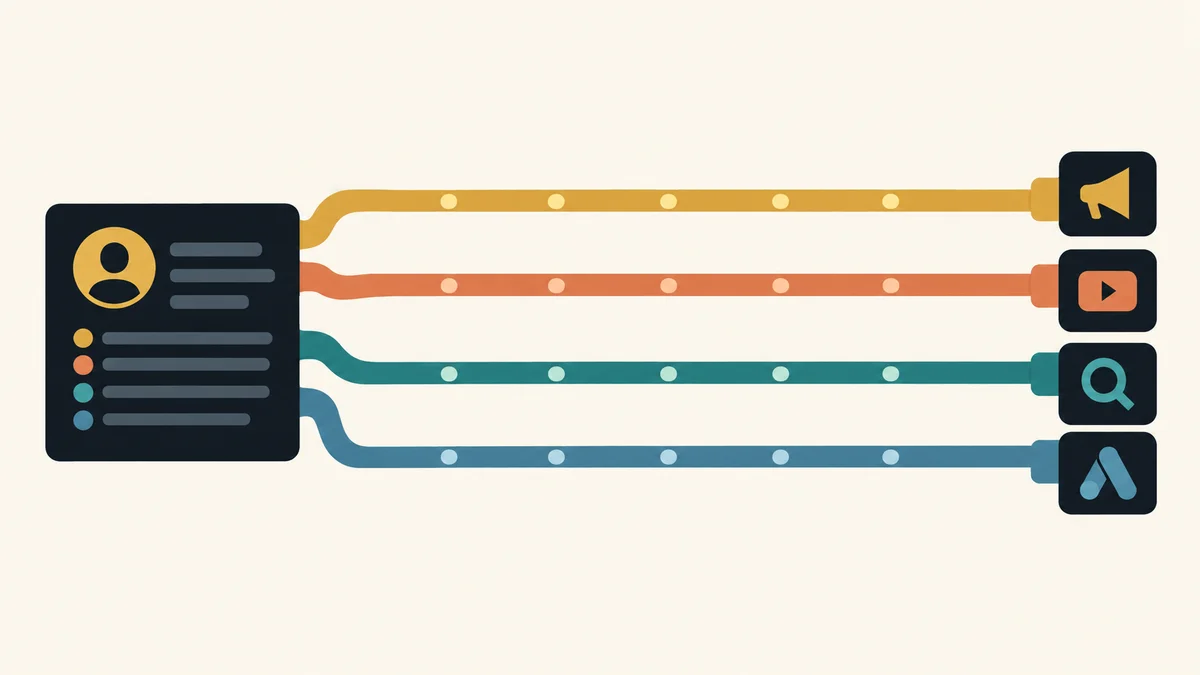
Offline conversions are sales outcomes recorded in a CRM, such as SQL or closed-won, that are sent back to an ad platform and matched to the original click or lead. The Google click ID (GCLID) is the identifier Google appends to an ad click URL, and it must be stored in the CRM to make that match. The table maps each route to its best fit.
| Route | Best fit | Main limit |
|---|---|---|
| Native connector (Google Data Manager) | Teams optimizing Google Ads from a supported CRM | Google only |
| Conversions API for CRM (Meta) | Teams with 200+ leads a month and early stage timing | Strict stage and timing rules |
| Scheduled CSV, HTTPS or SFTP upload | Microsoft Advertising, or any CRM without a connector | Manual upkeep, stale syncs |
| Middleware or attribution platform | Multiple CRMs or platforms, little engineering time | Extra cost, vendor-specific terms |
Sourced benchmark data: In The 2026 B2B SaaS Google Ads Waste Report (GrowthSpree, June 2026; 104 accounts, $78.0M spend), 91% of accounts had no GCLID-to-CRM connection and 78% of form fills never reached SQL. The accounts were an audited convenience sample, not a controlled test.
Four categories cover the market. Native routes are free but platform-specific. No-code middleware such as Zapier or Make moves CRM stages without code. Attribution platforms stitch journeys across channels: 75% of Dreamdata customers running LinkedIn Ads have integrated LinkedIn's Conversions API (PPC Land, reporting Dreamdata, 2026), though that sample likely overstates market adoption. Custom API builds suit teams with engineers. Verify pricing on each vendor's own site, since it was not verified for this guide.
Google Ads and Microsoft Advertising both accept click ID imports for up to 90 days after the click, so a cycle at or beyond 90 days needs intermediate stages such as SQL or opportunity (Stackmatix, 2026). Meta's CRM route is stricter: the optimization stage must happen within 28 days of the lead (Tofuads, 2026), which rules out closed-won.
Source: Dreamdata, 2026
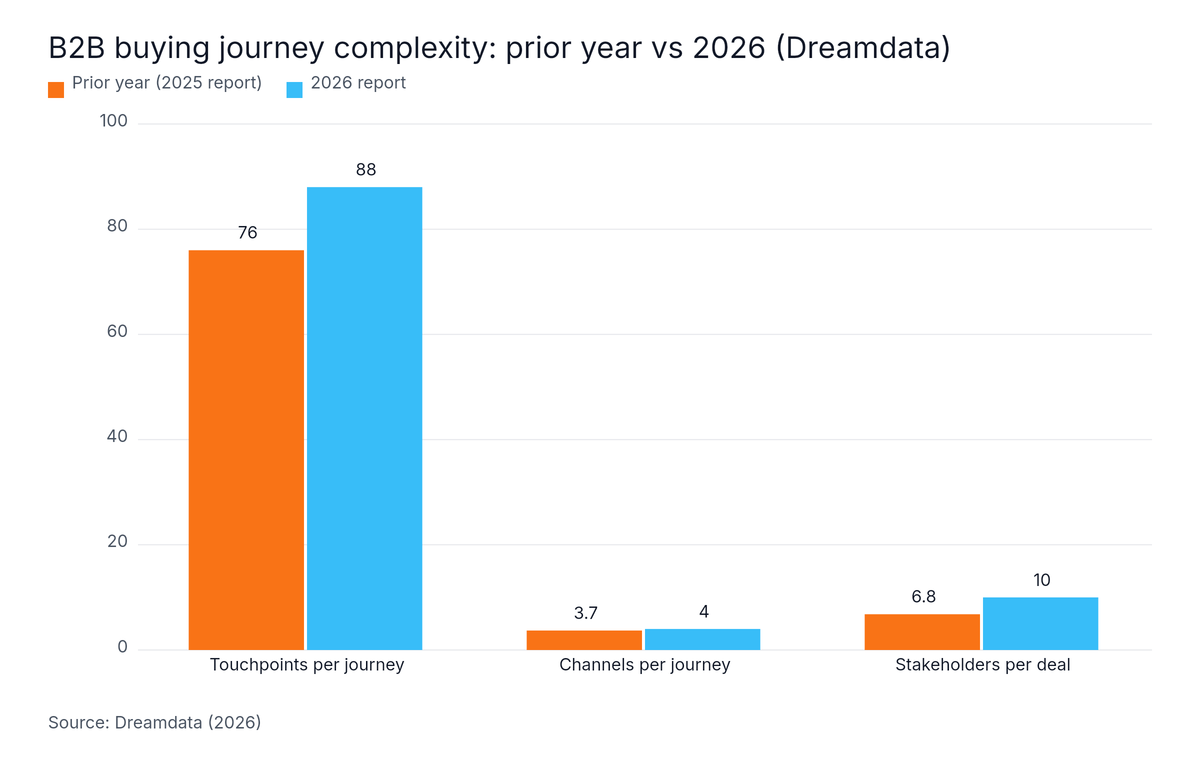
Sales cycles outrun most lookback windows. The average B2B journey from first marketing touch to closed revenue lengthened from 211 to 272 days (PPC Land, reporting Dreamdata, 2026). Buying journeys now average 88 touchpoints (up from 76), span 4 channels (up from 3.7) and involve 10 stakeholders (up from 6.8). Also, 81% of the B2B journey now happens outside the sales pipeline, up from 70% a year earlier (Dreamdata, 2026).
As Dreamdata's co-founder put it, "B2B deals are essentially won before sales get involved in the process." (Hedebrandt, Dreamdata, 2026) A single closed-won event is therefore a weak signal on its own.
Sourced benchmark data: The 2026 B2B SaaS Google Ads Waste Report (GrowthSpree, June 2026; 104 accounts, $78.0M spend) found a median sales cycle of 84 days, and default 7-day click attribution captured only 5% to 15% of revenue.
Send each stage as its own conversion action, with value on the last one. The table shows the usual fit by platform.
| Platform | Click ID window | Stage guidance |
|---|---|---|
| Google Ads | 90 days after click | SQL, opportunity, closed-won with value |
| Microsoft Advertising | 90 days after click | SQL, opportunity, closed-won with value |
| Meta Ads (CRM route) | Stage within 28 days of lead | SQL or meeting held, never closed-won |
Salesforce Sales Cloud data reaches Google Ads by storing the Google click ID (GCLID) on both Lead and Opportunity records, mapping it when a Lead converts, and importing staged events through Google Ads Data Manager: SQL first, closed-won with value last. Duplicate-merge rules must never overwrite the GCLID, or the match is lost.
Four checks matter for Salesforce Sales Cloud. Confirm current connector and object support in Google Ads Help before building, since those pages change.
Imports must land within 90 days of the click (Stackmatix, 2026). Where the click ID is missing, enhanced conversions for leads uses hashed email or phone as a fallback. As one agency put it, "Enhanced Conversions for Leads is what carries the long-tail deals back to Google Ads" (Priority Pixels, 2026).
The Data Manager API is Google's primary route for offline conversion data. From June 15, 2026, the Google Ads API stopped accepting new adopters of offline conversion imports, including enhanced conversions for leads. Existing importers keep access during a transitional period, with no removal date announced (PPC Land, 2026). Check whether any connector or custom script still calls UploadClickConversions. For cost context, see the paid search guide.
Microsoft Advertising offline conversion tracking starts with an Offline conversion goal, then uploads of Microsoft click ID (MSCLKID) matches by CSV, scheduled HTTPS or SFTP, or API within 90 days of the click. Microsoft Learn advises waiting two hours after creating the goal before uploading, and reporting can take up to six hours (Microsoft Learn, accessed October 2026).
The Microsoft click ID (MSCLKID) is the identifier Microsoft Advertising appends to an ad click URL. Like the GCLID, it has to be captured in a hidden form field and stored in the CRM, or no later match is possible. Bing offline conversion tracking uses this same Microsoft Advertising goal, so there is no separate Bing setup.
For API uploads, a single ApplyOfflineConversions request can carry at most 1,000 offline conversions. Duplicates with the same click ID and conversion time are ignored, with the first instance used (Microsoft Learn, 2026). For larger batches, split uploads across requests.
Meta Ads receives CRM stages through the Conversions API for CRM, which needs at least 200 leads a month, an optimization stage within 28 days of the lead and a stage conversion rate between 1% and 40% (Tofuads, 2026). A 90-day closed-won event does not qualify, so send SQL or meeting held instead.

Facebook Ads offline conversion tracking follows the same route, because Facebook and Instagram share Meta's ad system. Timing is strict. For Meta's CRM stage events, event_time must be no more than 7 days old and must be after the lead was created, so weekly batch exports are rejected and daily uploads are needed (Variafy, 2026).
Meta's Conversions API for CRM thresholds here come from secondary summaries by Tofuads and Variafy, and a legacy offline path may have different limits. Confirm against Meta's current developer guide before building.
Salesforce Sales Cloud uses Meta's AppExchange app or webhooks. Lead ID matching still applies only to Instant Form leads, though Meta's CRM-based conversion leads goal may now work with website forms as well (Tofuads, October 2026). Segment by channel too: reported B2B MQL-to-SQL rates differ by platform, so each channel deserves its own stage.
Monitor Google Ads offline conversion data weekly by checking what share of new CRM leads carry a click ID, reviewing upload errors in Data Manager, confirming the offline action is primary and the online duplicate is secondary, and reconciling Google Analytics with CRM pipeline. Silent GCLID capture failure is the most common break.
Sourced benchmark data: In The 2026 B2B SaaS Google Ads Waste Report (GrowthSpree, June 2026; 104 accounts), 91% of accounts had no GCLID-to-CRM connection and 89% ran default attribution before the audit. A weekly click ID coverage check catches the same gap early.
Google Analytics counts form fills and sessions. The CRM counts qualified pipeline. Per The 2026 B2B SaaS Google Ads Waste Report (GrowthSpree, June 2026), 78% of form fills never reach SQL, so a gap is expected until stages flow back. Reconcile by campaign, not in total. For the wider diagnosis, see diagnosing wasted ad spend.
Connecting CRM outcomes to ad platforms raised the qualification rate in all four B2B accounts that Growth Room tracked for 10 months (2026), with relative gains from 14% to 109%. With only four accounts and mixed cost results, treat the range as illustrative, not a benchmark.
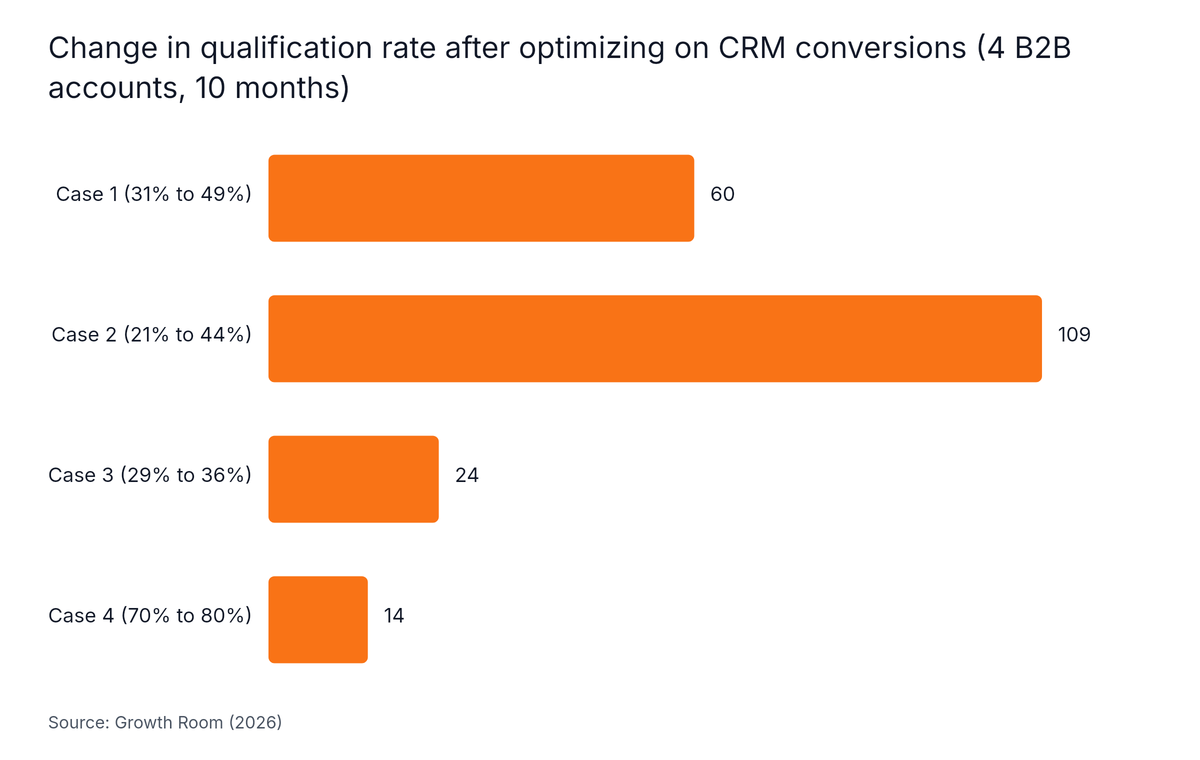
Source: Growth Room, 2026
The four accounts moved from 31% to 49%, 21% to 44%, 29% to 36% and 70% to 80% (a 60%, 109%, 24% and 14% relative change) after Google and Meta were connected to MQL, SQL and opportunity conversions (Growth Room, 2026). Cost results were mixed.
Sourced benchmark data: In The 2026 B2B SaaS Google Ads Waste Report (GrowthSpree, June 2026; 104 accounts), Performance Max (PMax) cost per SQL was $2,140 running blind and $620 with offline conversions. The report is an audit of convenience-sample accounts, not a controlled experiment.
Ranking ads on the same signal helps too. Across 1,412 ad variants, cost per SQL correlated with pipeline at r = 0.71, cost per lead at r = 0.23 and CTR at r = 0.09, and in 43% of A/B tests the higher-CTR winner produced fewer or costlier SQLs. Re-scoring ads by cost per SQL improved it by about 44% with no extra spend (The Paid Ads Pipeline Disconnect, GrowthSpree, June 2026). See ROAS for B2B SaaS for how to read return on ad spend alongside it.
Offline conversion tracking is not the right first fix for B2B SaaS accounts with too few leads, no click ID captured in the CRM, or no stage dates in the CRM. Meta's CRM route needs 200 leads a month, and every method fails if the click ID never reaches the CRM record.
Four limits apply:
Offline conversion tracking for B2B SaaS ad accounts is supported by four vendor types: the ad platforms' native connectors, no-code middleware, attribution platforms and custom API builds. Pricing and feature claims change often, so verify each vendor's current terms on its own site, and match the type to your CRM, ad platform and sales cycle before comparing names.
The official Google Ads offline conversion tracking steps are published in Google Ads Help, and the Microsoft equivalent is on Microsoft Learn. Both are living pages without a visible date, so confirm the current steps and check whether they reflect the June 15, 2026 Data Manager API change before you build.
A Google Analytics and CRM mismatch is closed by capturing the click ID in the CRM, importing SQL and closed-won stages as offline conversions, and reconciling both systems by campaign each week. Analytics counts form fills and sessions, while the CRM counts qualified pipeline, so the two will not match until stages flow back.
New offline conversion setups should use the Data Manager API, because from June 15, 2026 the Google Ads API stopped accepting new adopters of offline conversion imports. Existing importers keep access during a transitional period, with no removal date announced. Check whether your connector or custom script still calls UploadClickConversions.
Facebook Ads connects to a CRM through Meta's Conversions API for CRM, which receives lead stages such as SQL or meeting held rather than a 90-day closed-won event. Salesforce Sales Cloud uses Meta's AppExchange app or webhooks. Send events daily, because event_time must be within seven days of upload.
Offline conversion tracking works when the method fits the stack. Google Ads and Microsoft Advertising accept click ID imports for 90 days, and Meta's CRM route needs an early stage within 28 days. Salesforce teams can feed Google Ads through Data Manager once the GCLID survives lead conversion.
For a second opinion on your stack, bring your CRM, ad platforms and sales cycle to a free consultation. Meet with an expert from Ads for B2B SaaS. The full answer above does not depend on booking. Related reading: channel and budget allocation.
Written by
Ishan Manchanda
Ishan Manchanda is co-founder of GrowthSpree, a B2B SaaS marketing consultancy founded in 2017 that has managed $60M+ in ad spend across 300+ B2B SaaS companies. He focuses on demand generation, go-to-market strategy and pipeline growth, and has been featured in Silicon Valley Times, SaaS Mag and the Unbounce podcast.
© 2026 adsforb2bsaas.com All rights reserved.