Blog
How to Reduce Wasted Ad Spend in B2B SaaS Google Ads
Learn how to reduce wasted ad spend in B2B SaaS: causes, a waste rate formula, quartile benchmarks and a prioritised fix list that keeps total budget.
Offline conversion tracking sends CRM pipeline back to ad platforms. Learn how the GCLID loop closes, what to set up first, and why 7-day attribution fails.
 Ishan ManchandaNov 7, 2026
Learn how to reduce wasted ad spend in B2B SaaS: causes, a waste rate formula, quartile benchmarks and a prioritised fix list that keeps total budget.

Why ad platform conversions and CRM pipeline never match in B2B SaaS: attribution windows, form fills that miss SQL, a GCLID audit and a fix sequence.
Match your CRM, ad platform and sales cycle to the right offline conversion tracking method for Google Ads, Microsoft Ads, Meta and Salesforce.
Request a quote and our experts will contact you within 24 hours with tailored solutions and pricing.
adsforb2bsaas.com
Last updated: Nov 7, 2026
Offline conversion tracking is the practice of sending sales outcomes from a CRM, such as sales-qualified leads (SQLs) and closed-won deals, back to an ad platform by matching them to the original ad click, so bidding optimizes toward pipeline instead of form fills.
Most B2B SaaS accounts never close that loop. In The 2026 B2B SaaS Google Ads Waste Report (GrowthSpree, June 2026), 91% of 104 audited accounts had no link between the Google click ID and the CRM, and 78% of form fills never reached SQL status. The bidding algorithm learns from the wrong signal. This guide defines the concept, shows how the loop closes, lists what must exist before the first upload, and covers HubSpot, Facebook, LinkedIn and Reddit. For the wider cleanup, see diagnosing wasted ad spend.
Key Takeaways
- Google Ads offline imports bring CRM outcomes, such as SQLs and closed-won deals, back to the ad click that produced them.
- Default 7-day click attribution captures only 5% to 15% of revenue against an 84-day median B2B SaaS sales cycle (GrowthSpree, June 2026).
- The loop depends on one object: a Google click ID (GCLID) captured on the form, stored in the CRM and returned with each stage change.
- GCLID import matches within 90 days and enhanced conversions for leads within 63 days, both shorter than many enterprise cycles, so milestone events matter.
- Facebook, LinkedIn and Reddit each have their own server-side route and identifiers, but Google Ads is the anchor example for the whole loop.
Offline conversion tracking in Google Ads is a method of importing CRM events, such as a sales-qualified lead (SQL) or a closed-won deal, and tying each one to the ad click that started the journey. Google Ads then guides Smart Bidding with those events. It matters because 78% of form fills never reach SQL status (GrowthSpree, The 2026 B2B SaaS Google Ads Waste Report, June 2026).

Offline conversion tracking is a measurement method that records outcomes the ad platform cannot see on its own. A form fill happens on the website, so Google sees it. A demo held, an SQL accepted or a contract signed happens in the CRM, so Google sees nothing until the CRM sends it back. The upload closes that gap.
Online-to-offline conversion tracking is the same idea described from the buyer's side: an online click is linked to a sale that closes elsewhere, such as after a sales call. In B2B SaaS, nearly every valuable event is offline in this sense.
In Google Analytics, the same idea means sending offline events into GA4, usually through the Measurement Protocol with a client ID or through data import. GA4 uses those events for journey analysis and reporting. Google Ads import does a different job: it supplies the signal that Smart Bidding optimizes toward. Many teams need both, for different questions.
Platform conversions are not pipeline. Bidding automation optimizes toward whatever conversion it receives, so a form-fill signal buys more form fills. Teams that report clicks and cost per lead also find those metrics weak predictors. Across 1,412 ad variants, cost per lead correlated with pipeline at r = 0.23, while cost per SQL correlated at r = 0.71 (GrowthSpree, The Paid Ads Pipeline Disconnect, June 2026). The return on ad spend (ROAS) guide explains why the denominator matters.
Default 7-day click attribution fails in B2B SaaS because the sales cycle runs far longer than the window. The 2026 B2B SaaS Google Ads Waste Report (GrowthSpree, June 2026, 104 accounts, $78.0M spend) found that a 7-day click window captures only 5% to 15% of revenue against an 84-day median sales cycle, and 89% of audited accounts ran default attribution.
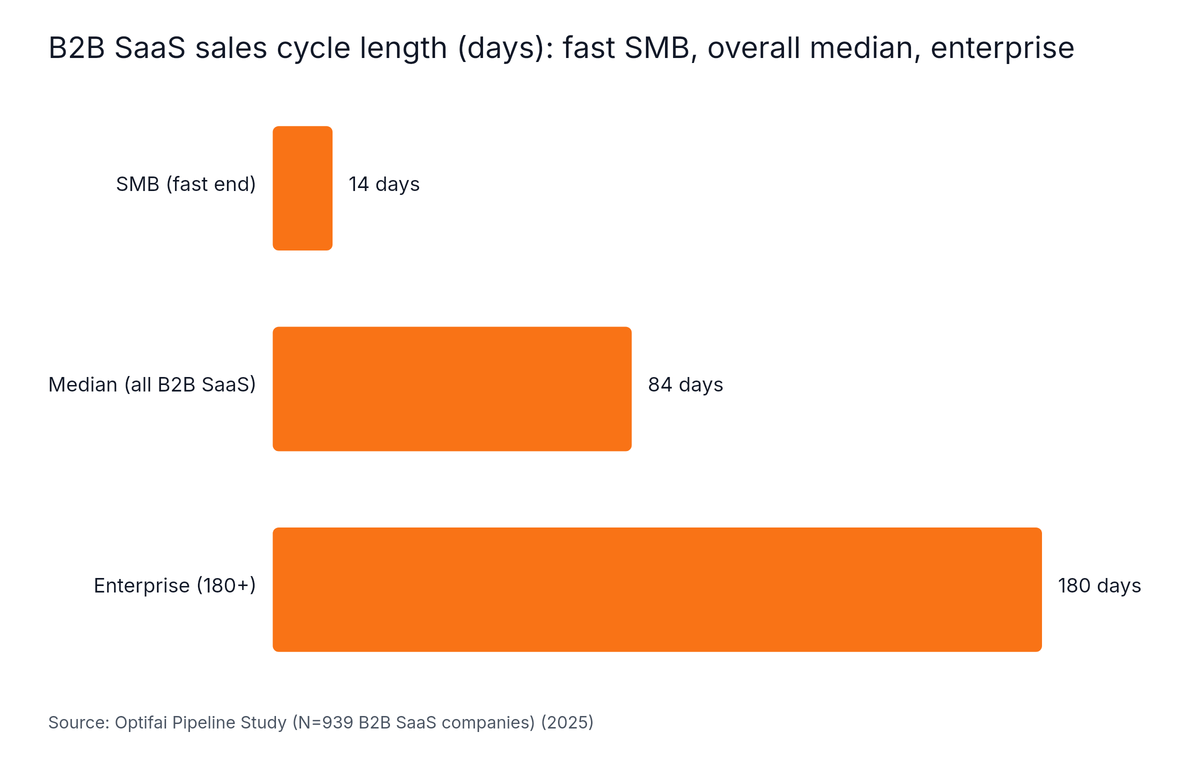
Source: Optifai Pipeline Study (N=939 B2B SaaS companies), 2025
The 84-day median is not an outlier. The Optifai Pipeline Study of 939 B2B SaaS companies puts the median at 84 days, against 14 days at the fast SMB end and 180 days at the enterprise end (Optifai, 2025). The same study reports that cycles have lengthened 22% since 2022. Buying committees have grown to 6.8 stakeholders from 5.4. That is one vendor's customer base, so treat it as a strong reference point rather than a universal law.
Cycle length varies sharply by deal size, and that spread decides which upload method will work for a given account.
| Segment | Annual contract value (ACV) | Typical sales cycle |
|---|---|---|
| SMB | Under $15K | 14 to 30 days |
| Mid-Market | $15K to $100K | 30 to 90 days |
| Enterprise | Over $100K | 90 to 180+ days |
Source: Optifai Pipeline Study, N=939 B2B SaaS companies (2025).
Our results: In The 2026 B2B SaaS Google Ads Waste Report (GrowthSpree, June 2026; 104 accounts, $78.0M spend), Performance Max (PMax) cost per SQL was $2,140 running blind versus $620 with offline conversions. A 90-day fix cut cost per SQL by 62% and moved average waste from 34.0% to 11.0%. Limitation: audited accounts are a convenience sample, not a controlled experiment.
The pattern still explains the symptom most inherited accounts show: spend rises, demo counts stay flat. The PPC lead generation guide covers what good lead quality looks like once the signal is fixed.
The GCLID-to-CRM loop closes in four moves. Google appends a click ID to the landing page URL, a hidden form field stores it on the CRM lead record, the CRM logs sales stages against that lead, and each stage change is uploaded to Google Ads with the click ID and a timestamp. In The 2026 B2B SaaS Google Ads Waste Report (GrowthSpree, June 2026), 91% of audited accounts had no such connection.
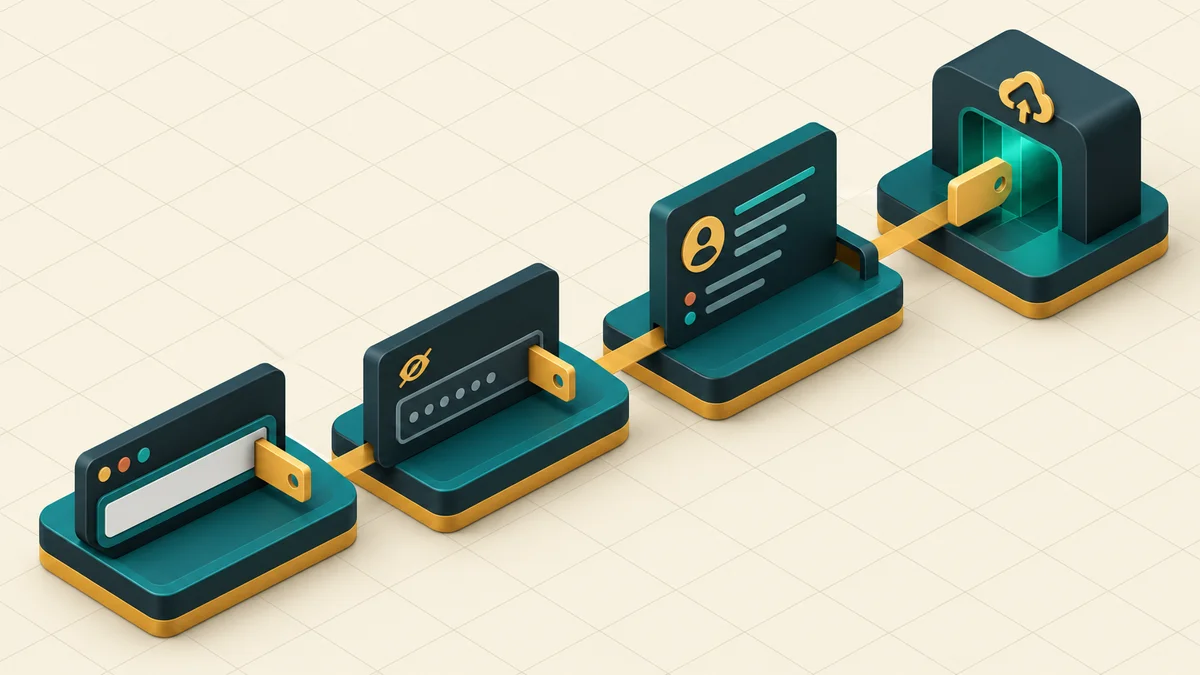
GCLID (Google click ID) is a unique identifier Google appends to the landing page URL when auto-tagging is on. It is the key that lets a later CRM event point back to one specific click.
Google's own guidance is direct: "To maximize accuracy, include GCLIDs with your uploaded events whenever possible." (Google Ads Help, 2026)
An inherited account usually fails at one of these points, so the list works as a diagnostic.
| Check | What to verify | Typical failure |
|---|---|---|
| Auto-tagging | Enabled at account level | No GCLID is ever appended |
| Hidden fields | GCLID, GBRAID and WBRAID fields survive redirects and form-builder changes | Redirects strip the parameter; redesigns drop the field |
| CRM field | A dedicated field per click ID, carried from Lead to Contact to Opportunity | Merges and conversions overwrite or lose the value |
| Conversion action | Type set to import from clicks, with an exact, case-sensitive name | Name mismatch rejects the upload |
| Timestamp | Event time falls after the click | Upload errors or wrong attribution |
| Wait time | 4 to 6 hours after creating the action before the first upload | Early uploads fail (Relevant Audience, 2026) |
The ad account audit checklist places this check inside a full review.
Google keeps GCLIDs matchable for 90 days. Conversions matched on hashed email or phone through enhanced conversions for leads can be uploaded up to 63 days after the ad click (Relevant Audience, 2026; DataCops, 2026). Both come from secondary summaries of Google documentation. Confirm them on Google's help pages before building around them.
| Item | Window | Why it matters |
|---|---|---|
| GCLID import match | 90 days from the click | Fits mid-market cycles, not enterprise |
| Enhanced conversions for leads match | 63 days from the click | Shorter than the 84-day median |
| Adjustments to uploaded conversions | Up to 55 days | Limits restating values late |
| Processing time | 24 to 48 hours | Reporting lags uploads |
The 84-day median sits between those windows. Enterprise deals running 90 to 180+ days fall outside both. The fix is to upload earlier milestones (SQL, demo held, opportunity) inside the window and to send hashed email alongside the GCLID. Google's developer documentation backs sending both: "We recommend including GCLIDs in your import requests where possible, even if you have Google tag set up to track enhanced conversions for leads." (Google for Developers, 2026)
Google Ads supports three methods for offline conversion tracking in a B2B SaaS setup: GCLID-based offline conversion import, enhanced conversions for leads that match hashed email or phone, and a native CRM connection through Google's Data Manager. Many accounts run GCLID and hashed identifiers together, because the methods fail in different cases (DataCops, 2026).

| Method | Identifier | Match window | Best for | Main weakness |
|---|---|---|---|---|
| GCLID offline conversion import | Google click ID | 90 days | Accounts with reliable form capture | Lost when the GCLID is dropped |
| Enhanced conversions for leads | Hashed email or phone | 63 days | Leads whose GCLID is missing | Shorter window; needs email at upload |
| Native CRM connection (Data Manager) | Both, from CRM fields | Follows the underlying method | HubSpot or Salesforce teams | First run limited to recent data |
Enhanced conversions for leads is a Google Ads method that matches uploaded conversions to ad interactions using hashed first-party data, such as email or phone, rather than relying on a click ID alone.
One agency measured 8% to 12% recovery from hashed identifiers on top of roughly 60% click-ID capture in a typical account (LGG Media, 2026). Google's own help page reports a median 10% increase in conversions for advertisers pairing first-party data with click IDs (Google Ads Help, 2026). Both are claims, not independent benchmarks, and neither discloses a sample size.
Data Manager API is Google's primary route for uploading offline conversions and enhanced conversions for leads data. Google Ads API stopped accepting new adopters of offline conversion imports on 15 June 2026, while existing integrations keep working (Google Ads Developer Blog, 2026). Google's help page says: "To avoid interruption, you can use the Data Manager API for current and future offline conversions and enhanced conversions for leads data uploads." (Google Ads Help, 2026) Guides that teach only the old CSV or API route are out of date.
Connecting HubSpot CRM data to Google Ads as offline conversions means storing the GCLID on the HubSpot contact, mapping lifecycle or deal stages to Google Ads conversion actions, and syncing stage changes through a native connection or Google's Data Manager. On its first run, the Data Manager connection imports only the last 14 days of CRM data (Tiltmetrics, 2026).
The same guide notes that HubSpot's native sync works on lifecycle stages, not deal stages, and has no backfill. That has two consequences for an inherited account:
Required HubSpot plan tiers differ between sources, so confirm them in HubSpot's knowledge base before committing. Whichever route is used, the GCLID field must exist on the contact first, or the connection has nothing to match. For account-wide context, see Google Ads vs LinkedIn Ads for B2B SaaS, which covers how measurement changes the channel verdict.
Offline conversions from a CRM improve Google Ads return on ad spend (ROAS) by giving bidding a revenue-linked signal instead of form fills. In The 2026 B2B SaaS Google Ads Waste Report (GrowthSpree, June 2026), Performance Max (PMax) cost per SQL was $2,140 running blind versus $620 with offline conversions.

Return on ad spend (ROAS) is revenue divided by ad spend. It only improves when the platform can see revenue, which is exactly what the upload provides.
Independent B2B SaaS studies with control groups do not appear in the research reviewed here. The available results come from agencies and vendors, often in other verticals, and should be read as illustrations.
| Source | Account type | Reported result | Caveat |
|---|---|---|---|
| Pilot Digital (2026) | B2B project-based advertiser | ROAS up 67.7% to 903% over 6 months; spend down 9.1% | Single client, no control group, not SaaS |
| Searchlight Digital (2026) | HVAC and plumbing contractor | 25% ROAS lift versus a control account | One account, vendor case study |
| Growthroom (2026) | 4 B2B ad accounts | Qualification rate up to 109% higher (21% to 44%) | Four agency clients, small sample |
| Google Ads Help (2026) | Advertisers pairing first-party data with click IDs | Median 10% increase in conversions | Platform claim, no sample size |
No sourced data in the research reviewed here says how long Smart Bidding takes to adjust after the signal changes, so set no promised timeline. When qualified volume is thin, optimizing on an earlier stage such as SQL gives bidding more events to learn from than closed-won alone.
Facebook, LinkedIn and Reddit Ads each take CRM outcomes through a server-side Conversions API (CAPI): the CRM sends a lead outcome plus a click or hashed identifier, and the platform matches it to the original ad interaction. LinkedIn's director of product management reports an average 31% increase in attributed conversions for CAPI users (AdExchanger, 2025).

| Platform | Typical identifiers | Route |
|---|---|---|
| Google Ads | GCLID, GBRAID, WBRAID, hashed email or phone | Data Manager API, native CRM sync |
| Facebook (Meta) | Click or lead ID, hashed email or phone | Conversions API with a non-web action source |
| LinkedIn Ads | li_fat_id, hashed email | CAPI, native CRM sync, CSV upload |
| Reddit Ads | rdt_cid, hashed email, IP | Conversions API |
Full setups for each platform are separate topics. This section covers the mechanics only.
Meta discontinued the standalone Offline Conversions API (offline event sets) in May 2025. CRM and offline events now go through the Conversions API into datasets, with a non-web action source (Variafy, 2026). Sources conflict on how many days after the event Meta accepts a CRM upload. Check Meta's Conversions API for CRM documentation before relying on any window. Guides that still describe offline event sets are out of date.
LinkedIn offers four ways to send conversions: the Insight Tag, the Conversions API, native CRM sync (HubSpot, Salesforce, Dynamics 365) and CSV upload. Most B2B accounts run more than one (DemandSense, 2026). LinkedIn's product director also reports a 39% average cut in cost per qualified lead from CAPI integrations (AdExchanger, 2025). One LinkedIn Ads and Zapier customer saw a 30% decrease in cost per qualified lead (Zapier, 2026). Both are vendor-reported and single-sourced. The channel verdict explains where LinkedIn fits.
Reddit Conversions API V3 (beta) adds omnichannel attribution, and the action source can be Website, App, Other or Offline (Twilio Segment, 2026). Reddit's help centre recommends running the Pixel and CAPI together with deduplication. Reddit-cited figures show server-side events can lift attributed purchase events by up to 19% when browser tracking breaks (Hightouch, 2026). That is Reddit's marketing claim about purchase events, not B2B lead data. Channel-level planning sits in ad channels and budget allocation.
Offline conversions are not the right first fix for every B2B SaaS account. The method needs a working CRM with stage data, a captured click ID, and enough qualified events for bidding to learn from. The published evidence for its payoff is mostly single-account agency case studies, not controlled B2B SaaS trials.
Five limits are worth stating plainly:
Offline conversion tracking in Google Ads is the import of sales outcomes that happen outside the browser, such as a qualified lead or closed-won deal, matched to the original ad click. It lets Google Ads report and bid on real pipeline events rather than form fills, so optimization reflects what sales actually accepted.
Google offline conversion tracking works by matching a CRM event to an ad click through an identifier. Google appends a GCLID to the landing page URL, the CRM stores it on the lead, and later stage changes are uploaded with that ID and a timestamp. Google Ads then credits the campaign and keyword that produced the click.
Offline conversion tracking in Google Analytics means sending offline events into GA4, typically through the Measurement Protocol with a client ID or through data import. GA4 uses those events for journey analysis and reporting. Google Ads import is the route to use when the goal is feeding a bidding signal to Smart Bidding.
Online-to-offline conversion tracking links an online ad click to a sale that closes elsewhere, such as in a CRM after a sales call. It matters in B2B SaaS because the median sales cycle is 84 days (Optifai, 2025), so platforms see form fills long before anyone sees revenue.
Google Ads connects clicks to CRM deals through a stored click ID. The GCLID is captured in a hidden form field, saved on the CRM lead, and carried to the contact and opportunity. When the deal changes stage, the upload sends that GCLID back, so Google credits the exact click.
Before enabling it in Google Ads, turn on auto-tagging, capture the GCLID in a hidden form field, store it in a dedicated CRM field, and create an import conversion action with an exact, case-sensitive name. Also confirm that CRM stage timestamps fall after the click and inside Google's matching window.
Enabling it in Google Ads takes five steps: turn on auto-tagging, capture the GCLID on every form, store it in the CRM, create a conversion action that imports from clicks, then upload stage changes with the click ID and timestamp. Google advises waiting 4 to 6 hours after creating the action before the first upload (Relevant Audience, 2026).
A CRM-to-ad-platform loop turns an ad account from a click reporter into a pipeline reporter. The evidence points to five takeaways:
Continue learning with the ad account audit, the wasted ad spend diagnosis and paid search for B2B SaaS.
Next step: Meet with an expert. Free consultation. Bring your ad account questions and brainstorm with a paid media expert.
By Ads for B2B SaaS Editorial Team. Last updated: October 28, 2026.
Written by
Ishan Manchanda
Ishan Manchanda is co-founder of GrowthSpree, a B2B SaaS marketing consultancy founded in 2017 that has managed $60M+ in ad spend across 300+ B2B SaaS companies. He focuses on demand generation, go-to-market strategy and pipeline growth, and has been featured in Silicon Valley Times, SaaS Mag and the Unbounce podcast.
© 2026 adsforb2bsaas.com All rights reserved.

