Blog
Offline Conversion Tracking for B2B SaaS: How It Works and Why the Default Setup Fails
Offline conversion tracking sends CRM pipeline back to ad platforms. Learn how the GCLID loop closes, what to set up first, and why 7-day attribution fails.
Compare geo tools for B2B SaaS demand gen teams on Google Ads, LinkedIn and Microsoft, see regional CPC benchmarks, and validate a new region with CRM data.
 Ishan ManchandaNov 11, 2026

Offline conversion tracking sends CRM pipeline back to ad platforms. Learn how the GCLID loop closes, what to set up first, and why 7-day attribution fails.

Tools to detect wasted ad spend in Google Ads, mapped to the signal each one exposes, with a triage order for B2B SaaS accounts above 30% waste.

Google Ads Performance Max for B2B: the settings, budget floor and offline conversion inputs that decide whether PMax drives SQLs or wastes spend.
Request a quote and our experts will contact you within 24 hours with tailored solutions and pricing.
Last updated: Nov 11, 2026
By Ads for B2B SaaS Editorial Team | Last updated: October 28, 2026
Geo tools for B2B SaaS demand gen teams are the native location and account-list controls inside Google Ads, LinkedIn Ads and Microsoft Advertising, used with CRM data to reach buyers who match the ideal customer profile (ICP) by region. An ideal customer profile (ICP) is the description of the companies and buyers most likely to become closed-won customers. Entering the US, UK, Canada or Europe? Platform defaults will not solve it. This guide compares the controls by channel and shows how to validate a region before committing budget. For wider channel choices, see the ad channels and budget allocation pillar.
Key Takeaways
- Geo-targeting for B2B SaaS paid media uses native controls on Google Ads, LinkedIn Ads and Microsoft Advertising, not one standalone tool.
- Location settings miss remote and hybrid buyers, so account lists should sit alongside location targeting.
- B2B SaaS Google Ads CPC and conversion rate differ by country, so a cheaper region is only better if cost per sales-qualified lead (SQL) holds up.
- CRM data ranked by pipeline, win rate and annual contract value (ACV) should decide which region gets budget first.
Geo-targeting for B2B SaaS demand gen teams relies mostly on native platform controls, not standalone software: Google Ads location settings, LinkedIn Ads member location, Microsoft Advertising's LinkedIn profile targeting and account-list display. Each reaches a different slice of buyers, so most teams combine two or three, then check results against CRM data.

Geo-targeting is the practice of limiting ad delivery to chosen countries, regions or accounts. The table summarises what each control does and where it stops.
| Channel | Geo control | What it reaches | Main limit |
|---|---|---|---|
| Google Ads (Search, Demand Gen) | Presence vs Presence or interest | People in, or interested in, the chosen location | Demand Gen only gained these controls on December 18, 2025 |
| LinkedIn Ads | Member location (where they live, or live and visit) | Members by profile or visit location | Remote workers employed elsewhere can fall outside it |
| Microsoft Advertising | LinkedIn profile company targeting | Employees of listed companies | 1,000 companies per ad group or campaign |
| Programmatic display with account lists | IP or company matching | Named accounts | Office IP ranges can miss people working from home |
Presence or interest is a Google Ads setting that also reaches people who show interest in a location, not just those physically there. Google added native location controls to Demand Gen campaigns, matching Search (Search Engine Land, 2025). As an editorial judgment, Presence is a sensible starting point for B2B SaaS, with Presence or interest reserved for short tests.
LinkedIn's help page says "You can reach member accounts based on where they live or where they live and visit using location." (LinkedIn Help, 2026) Location is only half the job on LinkedIn Ads. In audited accounts, decision-makers received only 33% of LinkedIn budget against a 60%+ target (Wasted LinkedIn Ads Spend in B2B SaaS, GrowthSpree, June 2026, 56 accounts, $9.4M spend).
Sourced benchmark data: Job function, seniority and company size targeting account for 67% of LinkedIn Ads waste, and the average LinkedIn Ads waste rate was 32.0% (Wasted LinkedIn Ads Spend in B2B SaaS, GrowthSpree, June 2026). Region is a filter on top of audience quality, not a replacement for it.
Microsoft's documentation is blunt about the account route: "To use LinkedIn targeting to target companies, you need to manually add company lists within the platform." (Microsoft Learn, 2026) The cap is 1,000 companies per ad group or campaign, so large lists must be split. For a channel-level verdict, read the Google Ads vs LinkedIn Ads comparison. For display options, see programmatic display platforms.
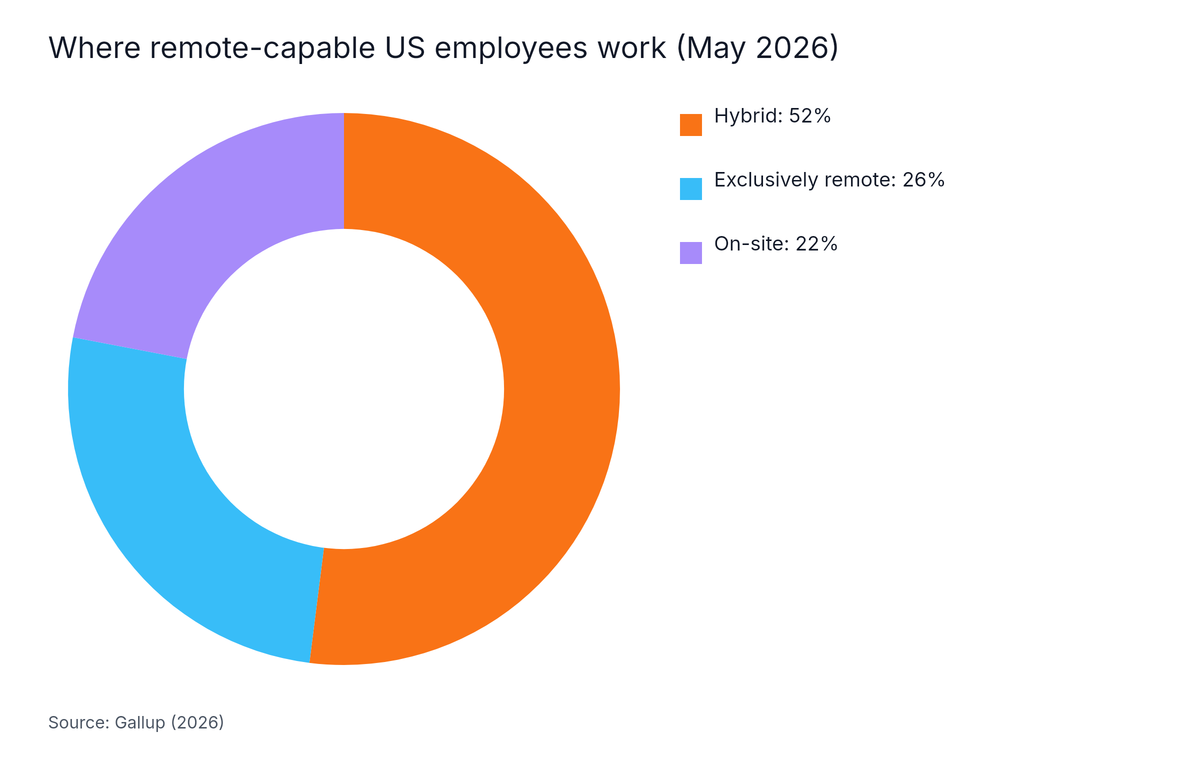
Platform location defaults miss remote B2B SaaS buyers because they target where a person is or lives, which can differ from where the employer is based. Among remote-capable US employees, 52% are hybrid and 26% fully remote (Gallup, 2026), so a buyer's location often differs from the company's office. Country targeting alone therefore fits the account poorly.

In May 2026 Gallup data, 22% of remote-capable US employees were on-site. Gallup says "Hybrid work has settled in as the clear preference and norm" (Gallup, 2026). Mobility goes further than home offices. In a February 2026 SurveyMonkey poll of 3,581 US workers, 37% said they would work remotely from another country if their employer allowed it (SurveyMonkey, 2026). That poll used a non-probability online panel, so treat it as directional.
Source: Gallup, 2026
The buying group adds a second problem. A typical B2B purchase involves 13 internal stakeholders and nine external participants (Forrester, 2026). Forrester notes "Today’s B2B buying groups are bigger, more networked, and increasingly led by digital natives." (Forrester, 2026) One contact's postcode says little about the group.
The workable fix, offered here as an editorial recommendation, is to pair location targeting with company lists. Target the account by employer, which Microsoft's documented company-list route supports, and use location only to set the region the team plans to sell in.
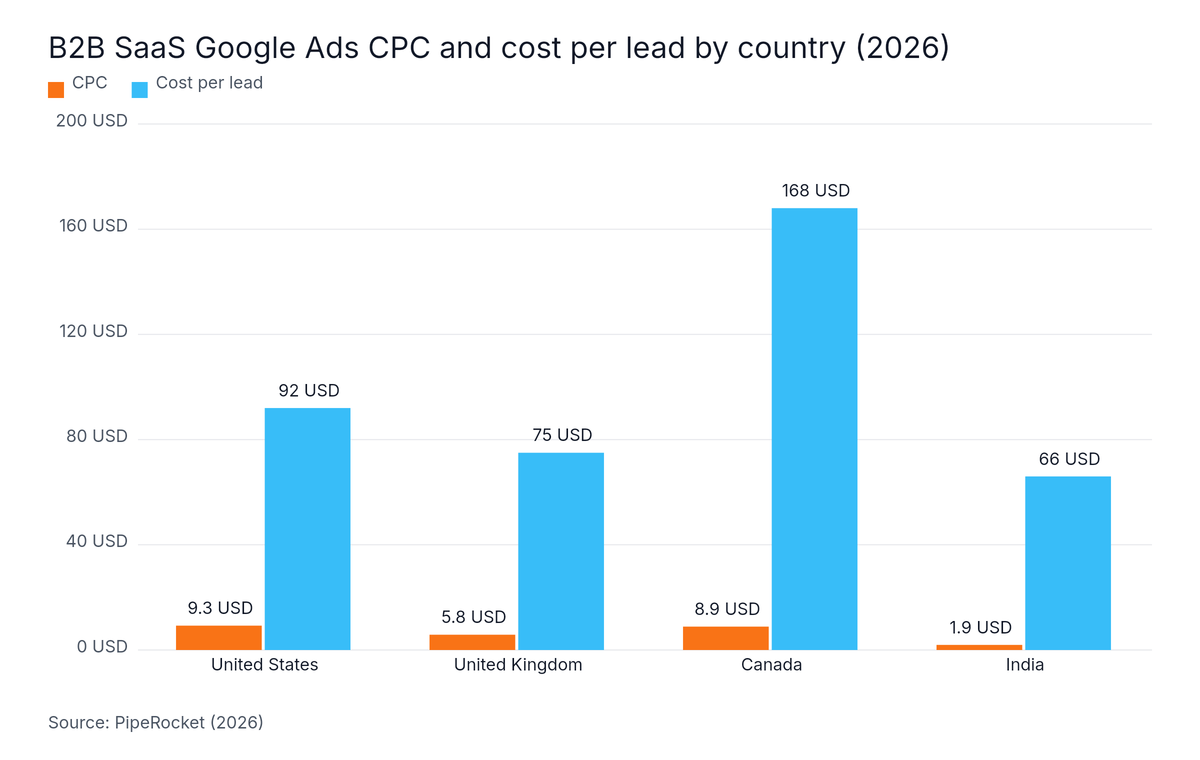
B2B SaaS Google Ads costs differ sharply by country. PipeRocket's August 2026 dataset of 53+ managed accounts shows a US CPC of $9.26 and CPL of $92, against $5.81 and $75 in the UK and $8.89 and $168 in Canada (PipeRocket, 2026). Cheaper clicks do not guarantee cheaper leads, so each region needs its own check.

| Country | Google Ads CPC | Cost per lead | Conversion rate |
|---|---|---|---|
| United States | $9.26 | $92 | 2.91% |
| United Kingdom | $5.81 | $75 | 5.91% |
| Canada | $8.89 | $168 | 2.58% |
| India | $1.94 | $66 | 1.46% |
Source: PipeRocket, 53+ managed B2B SaaS accounts, August 2026. Vendor first-party data, not an industry-wide sample. The publisher flags Canada as directional.
Source: PipeRocket, 2026
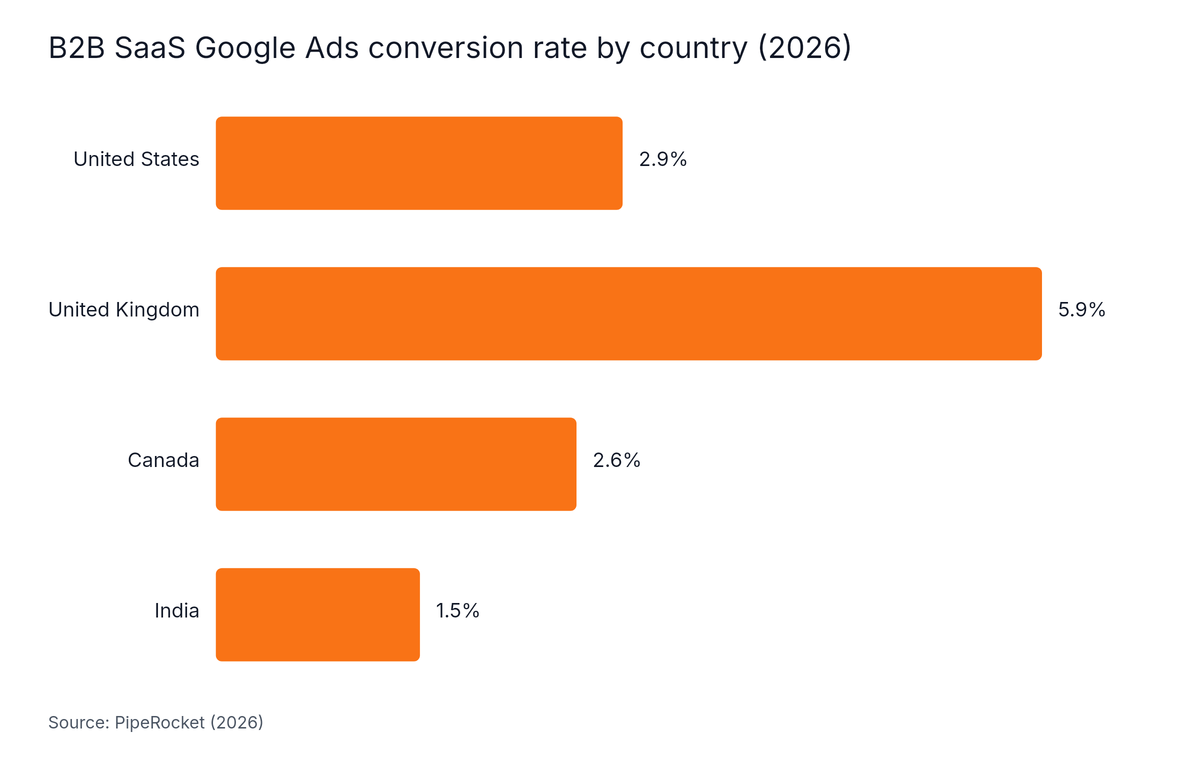
In the same PipeRocket dataset, UK accounts convert at 5.91% against 2.91% in the US (PipeRocket, 2026). Canada's cost per lead is the highest on the table despite a lower CPC than the US. Cheaper regions are more efficient only if conversion is validated.
Source: PipeRocket, 2026
An agency benchmark page says the US costs 40-60% more than the EU for B2B paid media, with UK, Germany and France 20-30% cheaper (42 Agency, 2026). That sample is about 70% North America. On LinkedIn Ads, North American targeting averaged a $10.11 CPC (range $7.91 to $13.71) across 87 B2B clients (42 Agency, 2026). Out-of-region impressions are therefore expensive.
Use these as ranges, not targets. For search-specific cost context, see paid search for B2B SaaS.
CRM data validates regional demand by ranking each country by pipeline created, win rate and annual contract value (ACV) from accounts already in the system, before any new spend. Cost per sales-qualified lead (SQL) is the number to trust: it correlated with pipeline at r = 0.71, against r = 0.09 for CTR (The Paid Ads Pipeline Disconnect, GrowthSpree, June 2026).

A sales-qualified lead (SQL) is a lead that sales has accepted as a real opportunity. Annual contract value (ACV) is the yearly revenue a customer contract brings in. The same study covered 1,412 ad variants, 96 accounts and $14.2M in spend, and found cost per lead correlated with pipeline at only r = 0.23. Buying groups of 13 internal and nine external participants (Forrester, 2026) also mean the CRM should be read at account level, not by single contact.
The table below is hypothetical and shows ranks only, not real figures. To build it, rank each country on each column: 1 means the highest pipeline created, highest win rate, highest ACV or the lowest cost per SQL. It shows how a region can look cheap on cost per SQL and still lose once win rate and ACV are counted.
| Country | Pipeline created | Win rate | ACV | Cost per SQL | Decision |
|---|---|---|---|---|---|
| Country A | 1 | 2 | 1 | 3 | Fund first |
| Country B | 2 | 1 | 2 | 2 | Fund second, test growth |
| Country C | 3 | 3 | 3 | 1 | Cheap leads, weak revenue: hold |
Sourced benchmark data: In The 2026 B2B SaaS Google Ads Waste Report (GrowthSpree, June 2026, 104 accounts, $78.0M spend), 91% of audited accounts had no GCLID-to-CRM connection, and 78% of form fills never reached SQL. A 90-day fix moved average waste from 34.0% to 11.0% and cut cost per SQL by 62%. Default 7-day click attribution captured only 5% to 15% of revenue against an 84-day median sales cycle.
Those gaps mean region-level numbers from the ad platform alone mislead. A full cleanup process is in the ad account audit checklist.
Meet with an expert. Free consultation. Bring your ad account questions and brainstorm with a paid media expert.
Testing demand in the UK or Europe means running a capped, separate campaign per region and judging it on cost per SQL, not clicks. UK companies send 75.1% of software spend to US vendors (Cledara, 2026), which supports testing UK demand, while median international revenue of 30% (SaaS Mag, 2026) frames what to expect.

Cledara's same page shows 6.9% of UK software spend going to British vendors (Cledara, 2026). The figures come from its own customer base, which may skew to startups and small businesses. SaaS Mag reports the 30% median from an ICONIQ Growth analysis of 33 companies listed between 2019 and 2024. It is a secondary citation.
Separate campaigns also make regional results easier to read than one blended campaign with location adjustments. For lead-quality benchmarks to hold the test against, see PPC lead generation for B2B SaaS.
Two recent changes affect European tests. Google is removing the campaign-level language setting from Search campaigns from late September 2026, so ads match users by the language of the ad (Hustle Marketers, verified September 16, 2026). Multi-language setups should therefore split campaigns by ad language. Separately, IT-Connect reports Google planned to use IP addresses for ad measurement and personalization from August 3, 2026, registered under IAB TCF Feature 3, which triggers consent requirements under European and UK law (IT-Connect, 2026). Both come from secondary sources, so confirm them in Google's documentation and with legal counsel.
CRM-validated geo-targeting for B2B SaaS paid media is not for teams with no CRM history, very small budgets or a single-country ICP. Without closed-won records by country there is nothing to validate against. With an 84-day median sales cycle and 78% of form fills never reaching SQL (The 2026 B2B SaaS Google Ads Waste Report, GrowthSpree, June 2026), early platform numbers mislead.
Consider Presence as the starting point for B2B SaaS, which is an editorial judgment, and use Presence or interest only for short validation tests. Google added the same location controls to Demand Gen campaigns on December 18, 2025 (Search Engine Land, 2025), so the choice now applies across Search and Demand Gen.
Target remote workers by account instead of location: upload company lists to LinkedIn Ads or Microsoft Advertising and match on employer, since a buyer's home address often differs from the company's. Microsoft Advertising caps company targeting at 1,000 companies per ad group or campaign (Microsoft Learn, 2026), so split large lists across campaigns.
Permanent location targets members by where they live, while recent location also reaches members where they live and visit, which suits events and travel. LinkedIn Help says "You can reach member accounts based on where they live or where they live and visit using location." (LinkedIn Help, 2026). Permanent location can miss remote workers employed elsewhere.
Country-level targeting is often too broad when the ICP concentrates in certain markets, because CPC and conversion rate vary by country. PipeRocket's August 2026 data shows UK accounts converting at 5.91% against 2.91% in the US (PipeRocket, 2026), so splitting campaigns by region and reading cost per SQL by country is safer than one national bucket.
Export closed-won and open pipeline by country, then rank each by pipeline created, win rate and ACV, and compare the ranking with ad cost per SQL by region. The 2026 B2B SaaS Google Ads Waste Report (GrowthSpree, June 2026) found default 7-day click attribution captures only 5% to 15% of revenue against an 84-day median sales cycle, so import offline conversions first.
Geo-targeting for B2B SaaS paid media works best when platform controls and CRM data are used together. The main points:
Next step: export closed-won and open pipeline by country from the CRM this week and compare it with current ad spend by region. If spend and pipeline do not line up, the guide to fixing wasted ad spend is the place to start.
Written by
Ishan Manchanda
Ishan Manchanda is co-founder of GrowthSpree, a B2B SaaS marketing consultancy founded in 2017 that has managed $60M+ in ad spend across 300+ B2B SaaS companies. He focuses on demand generation, go-to-market strategy and pipeline growth, and has been featured in Silicon Valley Times, SaaS Mag and the Unbounce podcast.
© 2026 Ads for B2B SaaS All rights reserved.