Blog
Offline Conversion Tracking for B2B SaaS: How It Works and Why the Default Setup Fails
Offline conversion tracking sends CRM pipeline back to ad platforms. Learn how the GCLID loop closes, what to set up first, and why 7-day attribution fails.
CPM pricing mechanics, LinkedIn and programmatic benchmarks, and a CPM-vs-CPC decision framework built for B2B SaaS sales cycles. No ecommerce framing.
Offline conversion tracking sends CRM pipeline back to ad platforms. Learn how the GCLID loop closes, what to set up first, and why 7-day attribution fails.
Learn how to reduce wasted ad spend in B2B SaaS: causes, a waste rate formula, quartile benchmarks and a prioritised fix list that keeps total budget.
Why ad platform conversions and CRM pipeline never match in B2B SaaS: attribution windows, form fills that miss SQL, a GCLID audit and a fix sequence.
Request a quote and our experts will contact you within 24 hours with tailored solutions and pricing.
Last updated: Oct 15, 2026
CPM advertising is a media-buying model where advertisers pay per one thousand impressions served; for B2B SaaS, it is the dominant buying method on LinkedIn and programmatic display, with 2026 benchmarks ranging from $42 to $65 CPM depending on format and geography.
Most B2B paid media guides treat CPM as a display concept borrowed from ecommerce. That framing breaks down in B2B SaaS, where sales cycles run a median of 84 days, buying committees span 6 to 10 people, and the buyer who eventually converts may have seen an ad a dozen times before touching anything trackable. Impression volume tells you nothing on its own. What matters is audience fit, frequency relative to cycle length, and whether the measurement setup can connect those impressions to pipeline.
This guide covers the CPM pricing mechanic from the auction upward, the fees that inflate raw rates into effective CPM, benchmarks by format and geography for the channels B2B SaaS ideal customer profiles (ICPs) actually use, a CPM-vs-CPC decision framework anchored to sales cycle stage, and the attribution traps that make CPM spend look worthless when it is not.
Key Takeaways
- CPM advertising charges per one thousand impressions, not per click. LinkedIn CPM for B2B advertisers averaged $63.19 spend-weighted in calendar 2025 (Digital Applied, 2026).
- The programmatic tech tax - DSP fees, B2B data costs, verification - adds 40 to 60% on top of raw media CPM, turning a $5 headline rate into $7 to $8 effective CPM (Stackmatix, 2026).
- 73% of the B2B buying journey happens before a buyer contacts a vendor (6sense / Green Hat, 2025). CPM campaigns build the familiarity that shapes later intent.
- "LinkedIn's CPM dropped 13.7% year-over-year to $42.29," creating a pricing window for brand campaigns (Refine Labs, 2026).
- The average time from a first LinkedIn impression to conversion is 320 days (Aimers, citing LinkedIn Ads Benchmarks Report 2026, 2026). Evaluating CPM spend at 30 days will systematically undervalue it.
- CPM advertising is not the right starting point for teams without account-level tracking and CRM integration. Measurement infrastructure must come first.
Sourced benchmark data: GrowthSpree's Wasted LinkedIn Ads Spend in B2B SaaS report (56 accounts, $9.4M in spend, June 2026) found that decision-makers received only 33% of LinkedIn budget in audited accounts, against a 60%+ target. Job function, seniority and company size targeting together accounted for 67% of LinkedIn Ads waste. A low CPM achieved by targeting broadly is not efficiency: it is often a signal that budget is flowing past the ideal customer profile entirely.
CPM advertising is a media-buying model where an advertiser pays a fixed rate per one thousand impressions served, regardless of clicks. CPM stands for cost per mille. The price is set by auction dynamics, inventory quality, audience targeting, and the buying method: direct reservation, programmatic open exchange, private marketplace, or platform self-serve. LinkedIn CPM for B2B advertisers averaged $63.19 spend-weighted across 138 advertisers in calendar 2025, per Metadata benchmark data reported by Digital Applied (2026).

On self-serve platforms like LinkedIn Ads, CPM is determined by a second-price auction: the winning advertiser pays one cent above the second-highest bid, not their own maximum bid. Floor prices - minimum CPMs set by the platform - put a ceiling on how low effective rates can fall regardless of competition levels.
On programmatic platforms, the auction operates through a demand-side platform (DSP) that bids into ad exchanges on the advertiser's behalf in real time. Most modern programmatic auctions use bid shading - a mechanism where the DSP submits a bid below the full maximum, based on historical clearing-price data, to reduce overpayment in first-price auction environments.
| Buying Method | Typical CPM Range | Audience Certainty | Minimum Commitment |
|---|---|---|---|
| LinkedIn self-serve | $2 to $65 by format | High - verified professional data | None |
| Programmatic open exchange | $2 to $15 media rate | Low - cookie or IP-based | None |
| Private marketplace (PMP) | $10 to $30 media rate | Medium - publisher-verified segments | Negotiated |
| Programmatic guaranteed | $20 to $50+ media rate | High - reserved inventory | Yes - impression guarantee |
Programmatic advertising is the automated buying and selling of digital ad inventory through technology platforms such as demand-side platforms (DSPs), where pricing is determined by real-time auction or pre-negotiated deals. A private marketplace (PMP) is a programmatic buying arrangement where a publisher invites a select group of advertisers to bid on premium inventory before it reaches the open exchange, typically at higher CPMs than open auction rates.
As DemandScience puts it: "CPM is appropriate for awareness-stage demand generation where your goal is reach and frequency, not immediate response." (DemandScience, 2026).
CPM advertising matters for B2B SaaS because 73% of the buying journey happens anonymously before a buyer contacts a vendor, per 6sense and Green Hat research (Column Five Media, 2025). Impression volume alone is misleading: buying committees of 6 to 10 people have sales cycles averaging 84 days, and the average time from a first LinkedIn impression to conversion runs 320 days, per LinkedIn Ads Benchmarks Report 2026 data cited by Aimers (2026). Total impressions mean nothing without audience fit and frequency controls.

The dark funnel problem makes CPM a strategic necessity, not just a format choice. According to Forrester research cited by Geisheker.com (2025), 68% of B2B buyers already have a front-runner vendor in mind at the start of the purchasing process, and that front-runner wins roughly 80% of the time. The implication is direct: CPM-based brand exposure before a buying cycle opens determines whether a SaaS vendor is on the consideration list at all.
"Sales cycles have lengthened 22% since 2022, driven by larger buying committees (6.8 stakeholders, up from 5.4)." (Optifai, 2026)
Longer cycles mean more impression touchpoints are required before any buyer self-identifies. An account that sees an ad 15 times across six months is in a fundamentally different position than one that sees it twice. Frequency, not raw volume, is the operative metric - and frequency only matters against a specific audience, not an undifferentiated pool of page views.
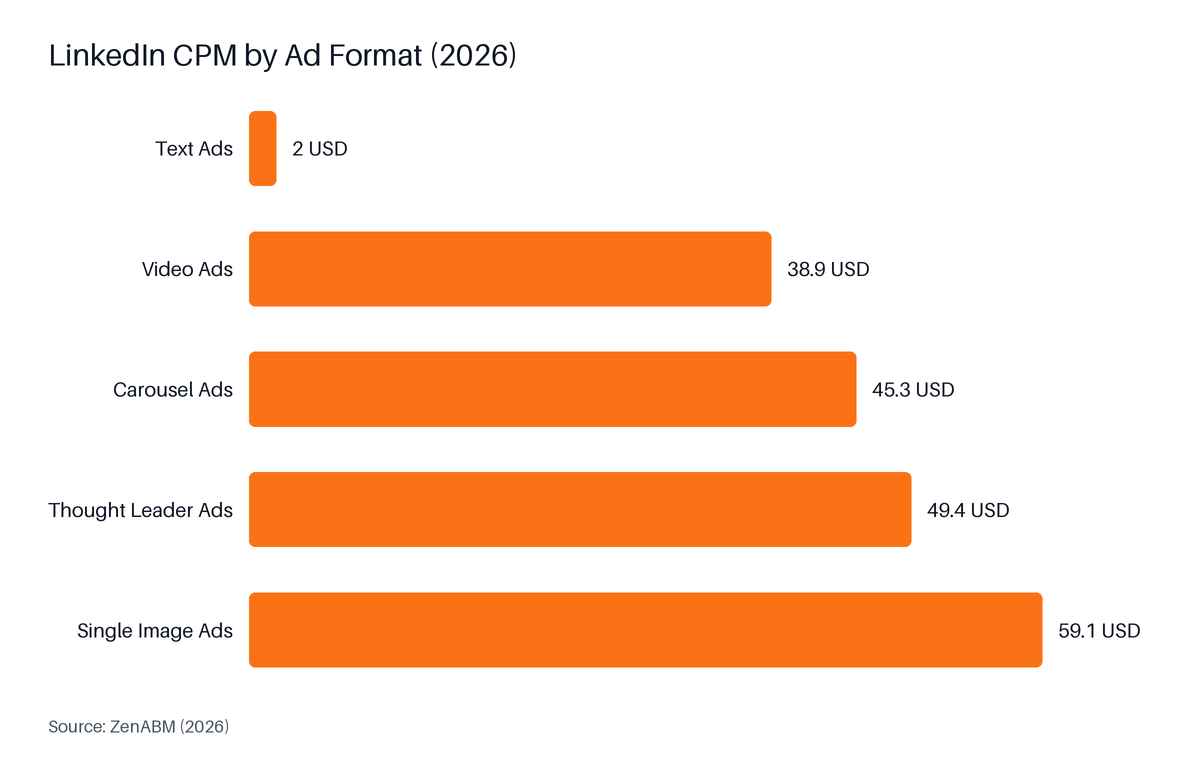
CPM prices differ substantially across the channels a B2B SaaS ideal customer profile (ICP) uses. LinkedIn Single Image Ads averaged $59.15 CPM and Text Ads approximately $2, per ZenABM (2026). Programmatic open-exchange CPM starts at $5 to $15 before fees. The raw media rate understates true programmatic cost: DSP fees, B2B data segments, and verification add 40 to 60% on top, turning a $5 media CPM into $7 to $8 effective CPM all-in, per Stackmatix (2026).

| Channel / Inventory Type | Typical CPM (Media Rate) | Audience Verification | B2B ICP Reach |
|---|---|---|---|
| LinkedIn Single Image Ads | $59.15 | Professional profile data | High |
| LinkedIn Thought Leader Ads | $49.37 | Professional profile data | High |
| LinkedIn Video Ads | $38.94 | Professional profile data | High |
| LinkedIn Text Ads | ~$2 | Professional profile data | Low (sidebar) |
| Programmatic open exchange (B2B) | $5 to $15 | Cookie / IP-based | Variable |
| Programmatic PMP (B2B intent) | $10 to $30 | Publisher + data segment | Medium to High |
| Programmatic guaranteed | $20 to $50+ | Reserved inventory | High |
LinkedIn format CPM figures from ZenABM (2026). Programmatic ranges from Stackmatix (2026). Media rate only - effective CPM is higher after tech stack fees.
Source: ZenABM, 2026
Programmatic CPM looks cheaper than LinkedIn until data costs are counted. Reaching verified B2B audiences through third-party intent data providers - such as Bombora or LiveRamp - adds $2 to $5 CPM on top of the media rate, per Stackmatix (2026). A $10 media CPM with a $3 data overlay becomes $13 before DSP margin, brand-safety tools, or ad serving are added.
Effective CPM (eCPM) is the true all-in cost per thousand impressions after every layer of fees is included. The formula: divide total campaign spend by total impressions delivered, then multiply by 1,000. In programmatic buying, tech stack costs - DSP margin, third-party intent data ($2 to $5 CPM from Bombora or LiveRamp), brand-safety tools, and ad serving - routinely add 40 to 60% above the headline media rate, per Stackmatix (2026), turning a $5 media CPM into $7 to $8 all-in.
The tech tax is the cumulative cost added to raw media CPM by the programmatic supply chain. At the high end of the 40 to 60% range, a $15 open-exchange CPM becomes $21 to $24 effective CPM - at which point the audience-quality gap between programmatic and LinkedIn narrows considerably.
Suppose a B2B SaaS team runs a programmatic display campaign. Total spend: $20,000. Impressions delivered: 2,500,000.
The headline rate was $5. The effective rate after the tech tax was $8. That $3 difference, multiplied across millions of impressions, is a material budget line. Always request a fee breakdown from any DSP or programmatic partner before committing budget: ask for media CPM, data CPM, platform margin, and any third-party verification costs billed separately.
CPM buying suits awareness and frequency goals: repeated exposure to the same accounts across a long sales cycle, not immediate response. CPC buying suits in-market demand capture, where a buyer is already searching and needs directing to a landing page or demo form. For B2B SaaS, the choice maps to funnel stage: CPM for dark-funnel brand building before intent surfaces, CPC for converting demonstrated interest. The B2B tech sales cycle averaged 6.5 months in 2025, per Ebsta and Pavilion data cited by Gradient Works (2025).

Use CPM buying when:
Use CPC buying when:
| Scenario | Recommended Buying Model | Why |
|---|---|---|
| Building awareness in a named account list | CPM | Frequency over a defined audience, no click required |
| Capturing in-market search intent | CPC | Click signals intent; pay for intent |
| Committee-level saturation ($50K+ ACV) | CPM | Multiple stakeholders, none searching today |
| Mid-funnel retargeting of site visitors | CPM or CPC | CPM for frequency; CPC for direct response |
| Competing for branded search terms | CPC | High-intent, short attribution |
| Testing a new channel with a small budget | CPC first | Faster feedback loop before committing to brand spend |
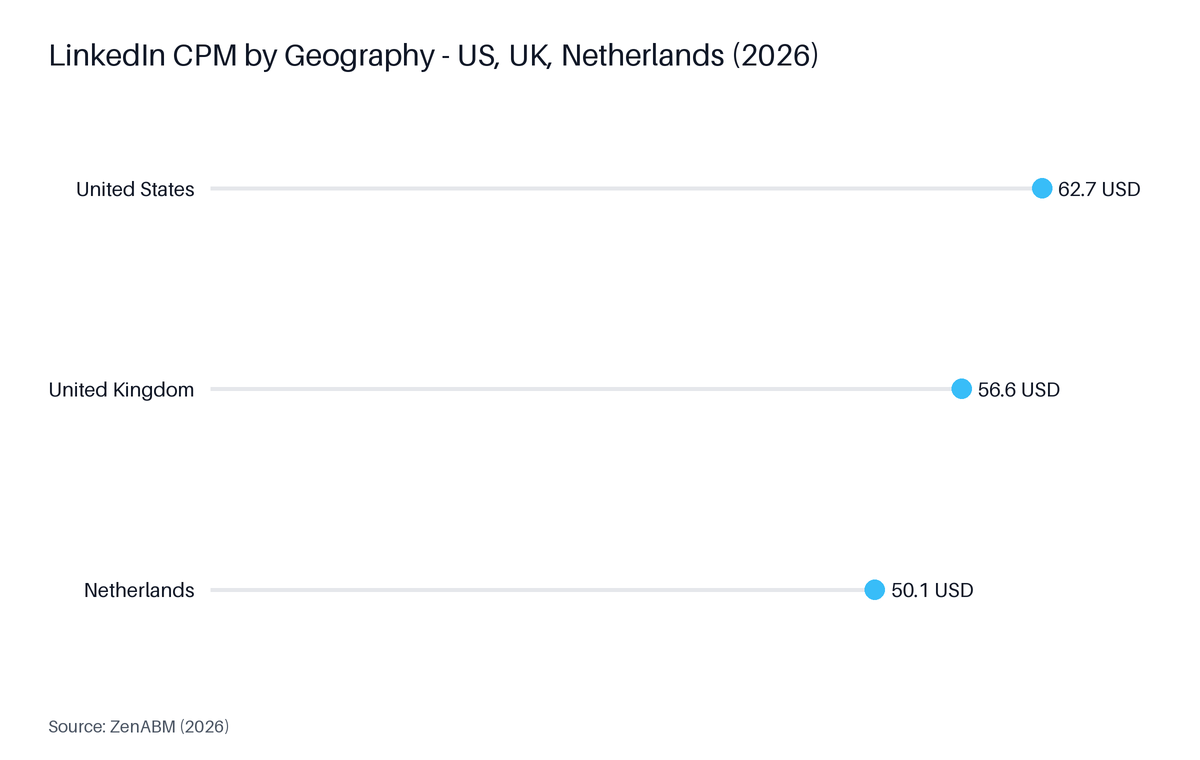
LinkedIn CPM for B2B advertisers averaged $63.19 spend-weighted in calendar 2025 across 138 advertisers spending $57.6M, per Metadata benchmark data reported by Digital Applied (2026). In Q1 2026, Refine Labs reported that "LinkedIn's CPM dropped 13.7% year-over-year to $42.29" for awareness campaigns (Refine Labs, 2026). By geography in 2026, the US averaged $62.67, the UK $56.62, and the Netherlands $50.08, per ZenABM (2026). Format drives the widest spread: from $2 for Text Ads to $59.15 for Single Image Ads.
Source: ZenABM, 2026

Sourced benchmark data: GrowthSpree's Wasted LinkedIn Ads Spend in B2B SaaS report (56 accounts, $9.4M in spend, June 2026) found that decision-makers received only 33% of LinkedIn budget in audited accounts, against a 60%+ target. Job function, seniority and company size targeting together accounted for 67% of waste. A CPM that looks efficient at the platform level often reflects over-delivery to low-seniority or out-of-ICP audiences - not genuine reach among buyers.
The US commands a premium: LinkedIn's professional audience is densest there and most actively targeted by B2B advertisers. UK and European markets run 10 to 20% lower. B2B SaaS teams running multi-geo campaigns can extend reach by shifting incremental budget toward lower-CPM markets, but the trade-off is audience size. Smaller account lists in non-US markets can tip frequency into overexposure quickly.
| Geography | LinkedIn CPM (2026) |
|---|---|
| United States | $62.67 |
| United Kingdom | $56.62 |
| Netherlands | $50.08 |
Source: ZenABM (2026). Proprietary report; sample and methodology not disclosed by ZenABM.
Thought Leader Ads are a LinkedIn Ads format that promotes organic posts from individual LinkedIn members as sponsored content, attributed to the person rather than the company page. In 2026 they averaged $49.37 CPM - meaningfully below Single Image Ads at $59.15-while maintaining feed placement. For B2B SaaS teams trying to extend executive or practitioner reach without paying the Single Image premium, Thought Leader Ads are a cost-efficient format to test.
Text Ads at approximately $2 CPM are the cheapest LinkedIn option, but sidebar placement limits attention and click-through. The low CPM reflects low premium, not high efficiency.
Standard 30-day CPM evaluation fails B2B SaaS because buying cycles run far longer. The average time from a first LinkedIn impression to conversion is 320 days, and from first engagement to conversion is 235 days, per LinkedIn Ads Benchmarks Report 2026 data cited by Aimers (2026). A CPM awareness campaign evaluated at 30 days will show zero pipeline - not because it is failing, but because the sales cycle has not completed. Default 7-day click attribution captures only 5% to 15% of revenue against an 84-day median sales cycle (GrowthSpree, G26, June 2026).
The mismatch between CPM campaign timelines and standard attribution windows is the most common reason CPM spend gets cancelled before it has had time to work.
Track these signals during a CPM awareness campaign, before demanding pipeline attribution:
A minimum sensible evaluation window for a CPM brand awareness campaign in B2B SaaS is 90 days for mid-funnel lift signals. Full pipeline attribution requires six to nine months of data.
CPM advertising is not the right starting point for every B2B SaaS team. Teams without account-level tracking and CRM integration cannot evaluate it honestly, and small account lists exhaust frequency quickly. GrowthSpree's Paid Ads Pipeline Disconnect study (1,412 ad variants, 96 accounts, $14.2M spend, June 2026) found that 78% of form fills never reach sales-qualified lead (SQL) status - meaning CPM-influenced pipeline is invisible without SQL-level tracking in place.
Sourced benchmark data: GrowthSpree's Paid Ads Pipeline Disconnect study (1,412 ad variants, 96 accounts, $14.2M in spend, June 2026) found that cost per SQL correlated with pipeline at r=0.71, while cost per lead correlated at only r=0.23. Without SQL-level data flowing back from the CRM, teams optimising a CPM campaign on platform metrics alone are measuring the wrong thing. CPM spend cannot be evaluated honestly unless closed-won and SQL data is connected to the ad platform.
Specifically, CPM advertising is a poor fit when:
LinkedIn CPM averaged $63.19 spend-weighted across 138 B2B advertisers in calendar 2025, per Metadata benchmark data reported by Digital Applied (2026). By format, Single Image Ads averaged $59.15, Thought Leader Ads $49.37, and Text Ads approximately $2. In Q1 2026, LinkedIn CPM dropped 13.7% year-over-year to $42.29 for awareness campaigns, per Refine Labs (2026). A CPM in the $40 to $65 range is typical; anything above $70 warrants a frequency and audience-size audit.
LinkedIn CPM runs $40 to $65 for most B2B SaaS formats, while programmatic open exchange CPM typically runs $5 to $15 before fees. The programmatic tech tax - DSP fees, third-party data costs, and verification - adds 40 to 60% on top of raw media rates, so a $5 media CPM becomes $7 to $8 effective CPM all-in, per Stackmatix (2026). LinkedIn's higher CPM reflects professional audience verification; programmatic's lower headline rate often understates true cost.
CPM buying suits awareness and frequency goals: reaching the same accounts repeatedly across a long sales cycle before buyers surface through trackable intent. CPC is more appropriate when the goal is driving clicks to a landing page or demo form from a warm or in-market audience. For B2B SaaS teams with sales cycles of 84 days or longer, CPM campaigns build the familiarity that improves conversion rates on downstream CPC and search campaigns.
A low CPM can mean cheap inventory that does not reach the ideal customer profile (ICP). In programmatic, open-exchange inventory can appear at $2 to $5 CPM but deliver impressions across irrelevant sites. For B2B SaaS, audience quality matters far more than raw CPM. The correct measure is cost per thousand ICP-fit impressions. A LinkedIn CPM of $60 reaching verified director-level buyers often outperforms a $5 programmatic CPM hitting anonymous traffic.
Effective CPM (eCPM) equals total campaign cost divided by total impressions, multiplied by 1,000. In programmatic buying, the tech stack adds fees: demand-side platform (DSP) margins, third-party data segments ($2 to $5 CPM from providers like Bombora and LiveRamp), brand-safety verification tools, and ad serving. Stackmatix (2026) puts the combined tech tax at 40 to 60% above raw media CPM, meaning a $5 media rate becomes $7 to $8 all-in.
Yes. LinkedIn CPM in 2026 averaged $62.67 in the United States, $56.62 in the United Kingdom, and $50.08 in the Netherlands, according to ZenABM (2026). Non-English-speaking European markets and APAC markets generally run lower. B2B SaaS teams running multi-geo campaigns can shift budget toward lower-CPM markets to extend reach, but audience size shrinks outside the US, which can increase frequency past the point of diminishing returns on smaller account lists.
The B2B buying journey averages 320 days from first LinkedIn impression to conversion, per LinkedIn Ads Benchmarks Report 2026 data cited by Aimers (2026). Evaluating a CPM awareness campaign at 30 or 60 days against pipeline will almost always show zero return - not because the campaign is failing, but because the sales cycle has not completed. A minimum evaluation window of 90 days is needed to see mid-funnel lift, with full pipeline attribution requiring six to nine months of data.
CPM advertising is a rational budget allocation for B2B SaaS teams with high annual contract value (ACV), long sales cycles, and defined account lists - provided the measurement infrastructure exists to evaluate it honestly. The mechanics are straightforward: pay per thousand impressions, manage frequency against the sales cycle, and account for the full effective CPM once tech stack fees are counted. The 2026 benchmarks give a working range: LinkedIn CPM runs $40 to $65 for most B2B formats, with format and geography creating the widest spread. Programmatic looks cheaper on the headline rate but often closes the gap once the 40 to 60% tech tax is applied.
The deeper issue for B2B SaaS is attribution. A 320-day average from first impression to conversion means a CPM campaign evaluated at 30 days will look like a failure regardless of what it is actually doing. The correct response is not to cancel the spend - it is to build the tracking that connects impressions to accounts, and accounts to pipeline.
The decisions that follow - which programmatic platforms to test, how to structure the media mix, and how ChatGPT Ads fit into a B2B awareness strategy - are covered in the programmatic display platform guide and the ChatGPT Ads guide for B2B SaaS, both publishing as part of this series. Links will be added here when each page goes live.
Ready to make your ad spend produce pipeline, not just impressions? Meet with an expert for a free consultation. Bring your account questions and work through the channel and measurement decisions with a paid media specialist.
Ads for B2B SaaS Editorial Team. Source selection and review process will be described on the Methodology page. Published 13 October 2026. Sources: Digital Applied (2026), Refine Labs (2026), ZenABM (2026), Stackmatix (2026), Optifai (2026), Aimers / LinkedIn Ads Benchmarks Report 2026 (2026), 6sense / Green Hat via Column Five Media (2025), Forrester Buyers' Journey Survey via Geisheker.com (2025), Ebsta and Pavilion via Gradient Works (2025), DemandScience (2026), GrowthSpree G26 / L26 / PD26 / B26 (June 2026 and April 2026).
© 2026 adsforb2bsaas.com All rights reserved.