Request a quote and our experts will contact you within 24 hours with tailored solutions and pricing.
ChatGPT Ads for B2B SaaS: How They Work and Whether to Test Them
By Ads for B2B SaaS Editorial Team | Last updated: October 28, 2026
ChatGPT Ads are sponsored placements that OpenAI sells and shows inside ChatGPT conversations, and for B2B SaaS they are a small, unbenchmarked channel worth testing only with a capped budget and working sales-qualified lead (SQL) tracking. Six months in, OpenAI still reports no performance benchmarks across advertisers (Search Engine Journal, 2026). A team deciding where the next dollar goes has plenty of format detail and almost no cost per SQL data. This ChatGPT Ads guide for SaaS advertising strategy separates documented facts from speculation, then gives Series A and B teams a test-or-wait framework. For the wider picture, see ad channels and budget allocation.
Key Takeaways
ChatGPT Ads are bought by CPC or CPM and steered with context hints, not keywords; the announcements reviewed do not describe job-title targeting.
ChatGPT Ads appear only on Free and Go plans, so B2B buyers on Plus, Pro, Business or Enterprise seats are not reachable.
No cost per SQL or pipeline benchmark exists for B2B SaaS on ChatGPT Ads; the only B2B SaaS conversion rate published is a modeled projection.
A Series A or B team can test ChatGPT Ads with a capped budget over 60 to 90 days, but only after SQL tracking works in the CRM.
Teams without offline conversions, or with enterprise-only buyers, should wait before testing ChatGPT Ads.
How Do ChatGPT Ads Work for B2B SaaS Companies?
ChatGPT Ads are sponsored placements that OpenAI sells through its Ads Manager and shows inside ChatGPT conversations. Advertisers buy by cost per click (CPC) or cost per thousand impressions (CPM), steer relevance with written context hints instead of keywords, and send clicks to a landing page. OpenAI said on October 21, 2026 that more than 100,000 advertisers have run campaigns (OpenAI, 2026).
Abstract chat window with a single highlighted sponsored card among message bubbles
What are the newer ChatGPT Ads formats?
On October 5, 2026, OpenAI introduced a visual ad format shown during image generation and expanded measurement tools (OpenAI, 2026). Sponsored Agents are labeled, business-sponsored conversations that open after a user engages with an ad, tested with select US advertisers since September 16, 2026. OpenAI describes the idea this way: "a user can choose to start a clearly labeled conversation with a business-sponsored agent in ChatGPT" (The Next Web, quoting OpenAI, 2026).
For B2B SaaS, a sponsored conversation could one day qualify demo or trial requests. No performance evidence exists yet for either new format, so both belong in the unknown column. The same report names HubSpot as OpenAI's first CRM partner.
Who Sees ChatGPT Ads, and Can You Target B2B Buyers?
ChatGPT Ads appear only on Free and Go plans, per OpenAI's October 21, 2026 announcement (OpenAI, 2026), so B2B SaaS buyers on Plus, Pro, Business or Enterprise seats are out of reach. Targeting runs on written context hints rather than keywords, and the announcements reviewed do not describe job-title targeting. As of September 2026, 43.4% of ad-eligible US users had seen an ad (Similarweb, 2026).
Two doors, one open and one locked, representing free and paid plan audiences
How large is the reachable audience?
Reach is uneven. Across nine markets, the share of ad-eligible users who saw an ad runs from 27.8% in Mexico to 45.7% in the UK (Similarweb, 2026), so most eligible users have still not seen one. OpenAI now lists 89 countries.
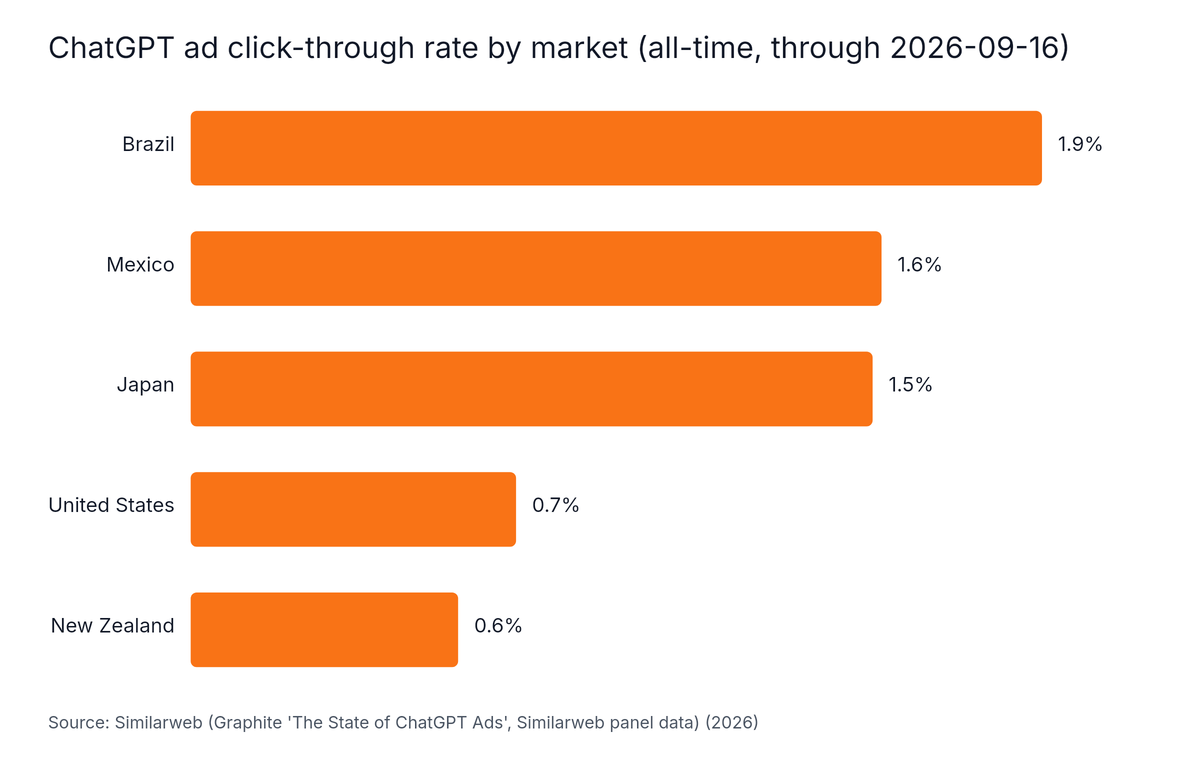
Click-through also varies by market. Similarweb panel data through September 16, 2026 shows Brazil at 1.91%, Mexico at 1.55%, Japan at 1.53%, the United States at 0.73% and New Zealand at 0.6% (Similarweb, 2026).
Horizontal Bar chart: ChatGPT ad click-through rate by market (all-time, through 2026-09-16). Highest: Brazil at 1.9%.
No published figure shows the share of B2B buyers who use ChatGPT on a free tier. That is the largest open question for this channel. A first-party check is cheap: ask customers and prospects on sales calls which ChatGPT plan they use.
What can you target, and what can you not?
Context hints are written descriptions of a conversation topic that tell ChatGPT Ads when an ad is relevant, in place of exact-match keywords. The table summarizes what the sources reviewed describe as of October 2026. Verify current limits in the OpenAI help center before building campaigns.
CPC and CPM, with conversion optimization added by August 2026 (OpenAI, 2026)
CPC is easier to cap in a small test
Relevance signal
Context hints, plus landing page content
Structure one buying situation per ad group
Negative keywords
Third-party coverage reports Negative Phrases for qualifying advertisers, dated to the October 5, 2026 announcement
Irrelevant clicks are only partly filterable
Job-title or seniority targeting
Not described in the announcements reviewed
Ideal customer profile (ICP) fit rests on message and page, not audience filters
Custom audiences
Added by August 2026 (OpenAI, 2026); eligibility rules for small lists not stated in the sources reviewed
Small B2B lists may not qualify
Measurement
ICP targeting is the main B2B loss. On LinkedIn Ads, job function, seniority and company size targeting account for 67% of waste in audited accounts (GrowthSpree, Wasted LinkedIn Ads Spend in B2B SaaS, 56 accounts, $9.4M spend, June 2026). Those are the filters that ChatGPT Ads do not document.
How Much Do ChatGPT Ads Cost and How Does the Auction Work?
ChatGPT Ads run on a relevance-weighted second-price auction: OpenAI picks the ad for each eligible conversation, and the winner pays based on the next-best bid rather than its own maximum. WebFX's summary of Ads Manager lists a default maximum CPM bid of $60 and a recommended starting CPC of $3 to $5 (WebFX, 2026).
Two auction paddles raised over a row of small conversation cards
What do bids and cleared prices look like?
A relevance-weighted second-price auction is one where ad relevance counts alongside the bid, and the winner pays just enough to beat the runner-up. Reported cleared CPMs have fallen to around $25 in some categories (WebFX, 2026). Recommended starting bids are not achieved costs, and the WebFX page date is approximate, so check current figures in the OpenAI help center.
One B2B industrial pilot raised its maximum CPC to $20 during a 30-day test (Windmill Strategy, 2026), a reminder that a bid sets the ceiling, not the price paid.
Metric
ChatGPT Ads
Google Ads (B2B SaaS median)
LinkedIn Ads (B2B SaaS)
CPC
$3 to $5 recommended start (not an achieved cost)
$8.50 to $14.00 non-brand
$8 to $25 by vertical
Cost per SQL
No published benchmark
$800 to $2,500
$800 to $8,000 by ACV tier
Published B2B SaaS pipeline data
None
Yes, by vertical
Yes, by ACV tier
The Google Ads and LinkedIn Ads figures come from SaaS Google Ads Benchmarks 2026 (GrowthSpree, April 2026) and Wasted LinkedIn Ads Spend in B2B SaaS (GrowthSpree, June 2026). Cost per SQL is total ad spend divided by the SQLs it produced, and it is the number the ChatGPT Ads column cannot yet fill. A cheaper click is not a cheaper SQL.
What can advertisers not see?
OpenAI offers limited auction-level reporting (Search Engine Journal, 2026). Bid learning is therefore slower than on Google Ads, where search term and auction data guide changes.
What Is a Good CTR or Conversion Rate for ChatGPT Ads, and What Is Still Unknown?
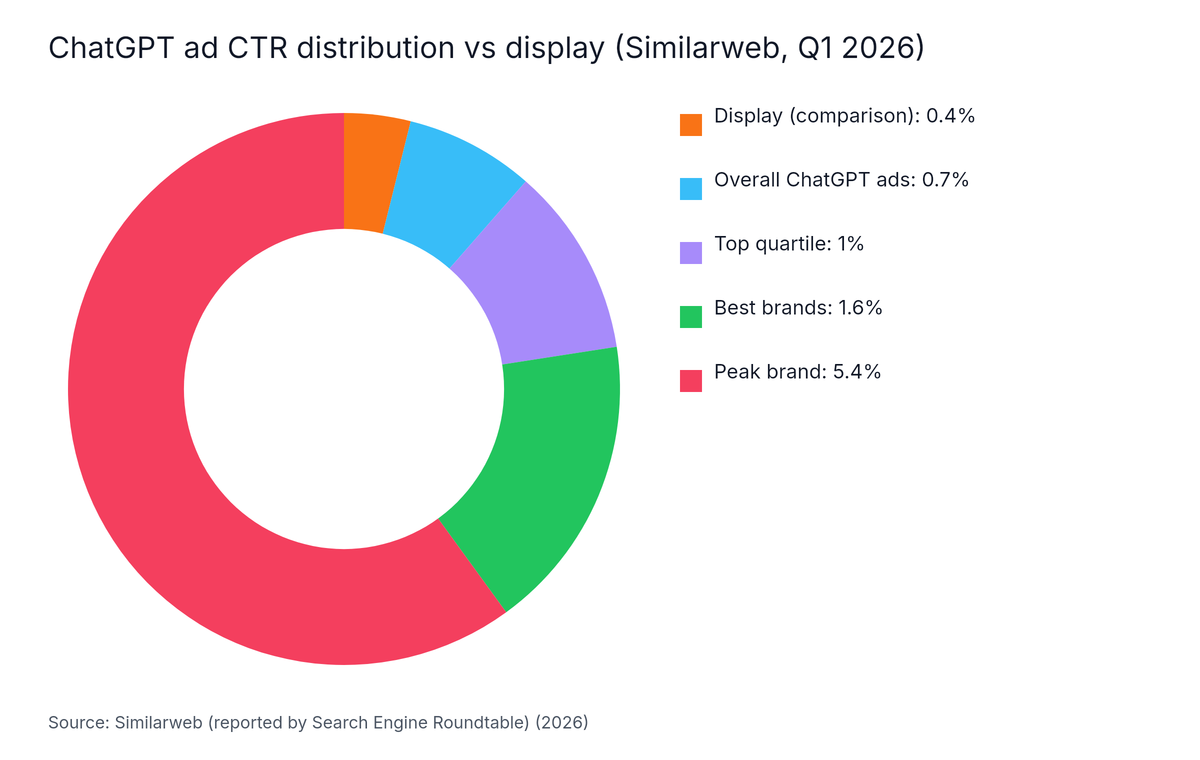
Published ChatGPT Ads performance is early and mostly not B2B-specific. Similarweb puts overall click-through rate at 0.68% in Q1 2026, with the top quartile at 1% and display at about 0.35% (Similarweb via Search Engine Roundtable, 2026). No cost per SQL, cost per opportunity or pipeline benchmark exists for B2B SaaS, and OpenAI reports no cross-advertiser benchmarks.
Donut chart: ChatGPT ad CTR distribution vs display (Similarweb, Q1 2026). Highest: Peak brand at 5.4%.
The same Similarweb data shows best brands at 1.57% and a peak of 5.4% (Similarweb via Search Engine Roundtable, 2026). The sample is worldwide, panel-based and not B2B-specific. A B2B industrial agency pilot saw about 40,000 impressions in one month, with CTRs of 0.65% for Manufacturing and 0.67% for Industrial, which it judged comparable to its LinkedIn Ads CTRs (Windmill Strategy, 2026). That is one agency, one month, and no SQL data.
What does the only B2B SaaS conversion figure represent?
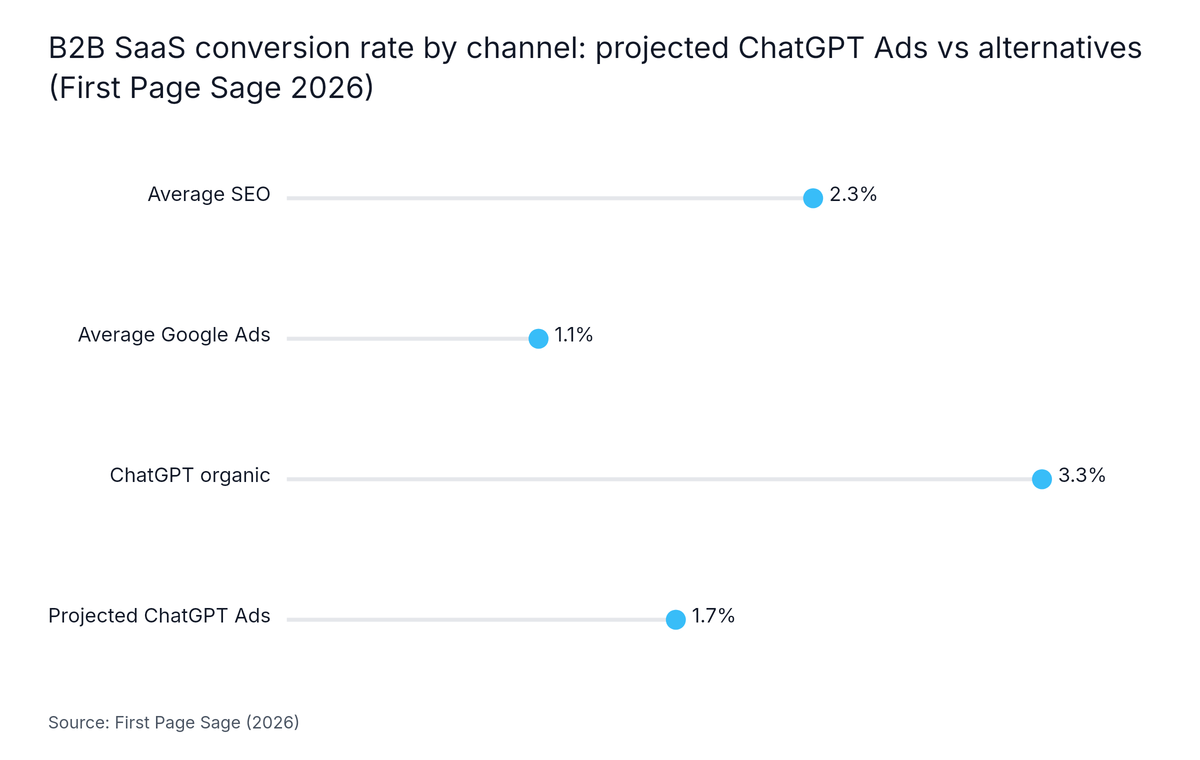
First Page Sage projects a 1.7% ChatGPT Ads conversion rate for B2B SaaS, up from 1.2% in its prior edition, against 1.1% for Google Ads. Across 17 industries the projections run from 0.2% to 6.3% (First Page Sage, 2026). The same report lists average SEO at 2.3% and ChatGPT organic at 3.3% (First Page Sage, 2026). These are modeled projections from an agency, not measured platform data, and they are not cost per SQL.
Lollipop chart: B2B SaaS conversion rate by channel: projected ChatGPT Ads vs alternatives (First Page Sage 2026). Highest: ChatGPT organic at 3.3%.
Click-through rate is a weak guide anyway. Across 1,412 ad variants, 96 accounts and $14.2M in spend, CTR correlated with pipeline at r = 0.09, cost per lead at r = 0.23 and cost per SQL at r = 0.71 (GrowthSpree, The Paid Ads Pipeline Disconnect, June 2026). In 43% of A/B tests, the higher-CTR winner produced fewer or costlier SQLs. For the cost-per-lead trap, see PPC lead generation for B2B SaaS.
Should a Series A or B B2B SaaS Company Test ChatGPT Ads?
A Series A or B B2B SaaS team should test ChatGPT Ads only with a capped, ring-fenced budget, and only after Google Ads and LinkedIn Ads report SQLs reliably. EMARKETER expects ads in AI chatbots to earn under $1 billion in 2026, about 3% of total AI advertising spend, and says "early tests buy learning, not scale" (EMARKETER, 2026).
A small ring-fenced square of coins on a larger ledger page beside a calendar
How do you set a test budget without a benchmark?
Work backward from your own funnel. The steps below are an editorial framework, not a published standard.
Connect SQL data first. Send SQL and closed-won data back as offline conversions, which are CRM outcomes uploaded to an ad platform so bidding learns from pipeline. In audited accounts, 91% had no Google click ID (GCLID)-to-CRM connection (GrowthSpree, The 2026 B2B SaaS Google Ads Waste Report, 104 accounts, June 2026). See the ad account audit checklist.
Set a cost per SQL ceiling. Use your own target, tied to annual contract value (ACV) and close rate. For reference, the median B2B SaaS cost per SQL on Google Ads is $800 to $2,500 (GrowthSpree, April 2026).
Derive the CPC ceiling. Max CPC equals the cost per SQL ceiling multiplied by your click-to-SQL rate.
Size the budget to produce SQLs. Clicks needed per SQL equal one divided by the click-to-SQL rate. Multiply by your expected CPC and the number of SQLs you need to judge the test.
Run 60 to 90 days. The median B2B SaaS sales cycle is 84 days (GrowthSpree, June 2026), so a 30-day read is too short to judge closed-won.
Here is a hypothetical example with assumed rates, not benchmarks. Say the ceiling is $1,500 per SQL and the click-to-SQL rate is 0.5%. Max CPC is $1,500 multiplied by 0.005, or $7.50. Each SQL needs 200 clicks. At an assumed $4 CPC, that is $800 per SQL, and five SQLs need about 1,000 clicks, or roughly $4,000. Replace every assumption with your own Google Ads or LinkedIn Ads data.
How do you measure ChatGPT Ads against SQLs and pipeline?
Measure on pipeline, not clicks. OpenAI announced expanded measurement tools and attribution partnerships on October 5, 2026 (OpenAI, 2026), and The Next Web reports HubSpot as the first CRM partner (The Next Web, 2026). Confirm in the OpenAI help center what lead-level data flows back to your CRM, and tag every ChatGPT Ads click with its own UTM parameters.
Sourced benchmark data: Fixing measurement pays on other channels. A 90-day fix moved average Google Ads waste from 34.0% to 11.0% and cut cost per SQL by 62% (The 2026 B2B SaaS Google Ads Waste Report, GrowthSpree, 104 accounts, $78.0M spend, June 2026).
What are sensible scale and kill rules?
Situation after the test window
Suggested action
SQLs tracked, cost per SQL at or below ceiling
Extend and raise budget in small steps
Cost per SQL above ceiling but below twice the ceiling
Rework landing page and context hints, then retest once
Cost per SQL above twice the ceiling after the full budget is spent
Teams that cannot tie clicks to SQLs in the CRM, sell mainly to enterprise buyers on managed ChatGPT seats, or need certainty before spending should wait on ChatGPT Ads. In 104 audited B2B SaaS Google Ads accounts, 91% had no Google click ID (GCLID)-to-CRM connection, so measurement gaps usually come first.
A closed gate with a signpost pointing back toward a measurement setup
Wait if any of these apply:
No SQL tracking. Default 7-day click attribution captures only 5% to 15% of revenue against an 84-day median sales cycle (GrowthSpree, June 2026), so a ChatGPT Ads test would read as noise.
Existing waste. Google Ads accounts averaged a 34.0% waste rate in the same study, about $255K per account per year. Fixing that first is a surer return; see how to diagnose wasted ad spend.
Enterprise-only ICP. Buyers on Business or Enterprise seats never see the ads.
Audience trust risk. In a Zappi survey, 40% of respondents said they would pay for an ad-free experience or move to another AI assistant if ads were introduced, and only 13% had no major concern (BestMediaInfo reporting on Zappi, 2026). The extract gives no sample size, so treat it as directional.
No tolerance for a null result. The channel has no benchmark to defend, and a failed test with no stated hypothesis becomes a political problem.
This guide has limits too. The performance figures are early, worldwide and not B2B-specific, and the conversion projection is modeled. Treat every number as an assumption to test.
Frequently Asked Questions
Do Plus, Pro, Business or Enterprise users see ChatGPT Ads?
ChatGPT Ads appear only on Free and Go plans, never on Plus, Pro, Business or Enterprise, according to OpenAI's October 21, 2026 announcement (OpenAI, 2026). For B2B SaaS, buyers on paid or company-managed seats cannot be reached, and no published figure shows how many B2B buyers use free tiers.
Can you use negative keywords in ChatGPT Ads?
ChatGPT Ads rely on context hints rather than keywords, so classic negative keywords do not apply. Third-party coverage reports Negative Phrases for qualifying advertisers, dated to the October 5, 2026 announcement, though the OpenAI page itself does not state this. Relevance is otherwise steered by one buying situation per ad group and a tightly written landing page.
Is there a benchmark cost per SQL for ChatGPT Ads?
A benchmark cost per sales-qualified lead (SQL) for ChatGPT Ads does not exist as of October 2026. No cost per opportunity or pipeline benchmark is published for B2B SaaS either. The only B2B SaaS conversion figure, 1.7% from First Page Sage (2026), is a modeled projection, so each team must calculate its own ceiling.
What is a good click-through rate for ChatGPT Ads?
Similarweb puts overall ChatGPT Ads click-through rate at 0.68% for Q1 2026 (2026), with the top quartile at 1% and display at about 0.35%. That data is not B2B-specific. Click-through rate also predicts pipeline poorly, so cost per SQL is the better judge of a B2B SaaS test.
Conclusion
ChatGPT Ads are a documented format with an undocumented return. Treat the channel as a bounded experiment, not a plan, and judge it on pipeline rather than clicks.
ChatGPT Ads run on CPC or CPM bids in a relevance-weighted second-price auction, with context hints instead of keywords.
Only Free and Go users see the ads, so paid and enterprise seats are excluded.
No B2B SaaS cost per SQL benchmark exists, and the 1.7% conversion rate is a projection.
Test only with SQL tracking in place, a cost per SQL ceiling and a 60 to 90 day window.
Stop at twice the ceiling, and judge on pipeline, not CTR.
For the pricing logic behind impression-based buying, read CPM advertising for B2B SaaS. Next step: bring your funnel numbers to Meet with an expert. Free consultation. Bring your ad account questions and brainstorm with a paid media expert.
Written by
Ishan Manchanda
Ishan Manchanda is co-founder of GrowthSpree, a B2B SaaS marketing consultancy founded in 2017 that has managed $60M+ in ad spend across 300+ B2B SaaS companies. He focuses on demand generation, go-to-market strategy and pipeline growth, and has been featured in Silicon Valley Times, SaaS Mag and the Unbounce podcast.
Expanded tools and attribution partnerships announced October 5, 2026 (OpenAI, 2026)
 Ishan ManchandaNov 14, 2026